
Lagina (modern day town of Turgut in Muğla province) was an ancient religious sanctuary in Caria, dedicated to the goddess Hekate. Administratively connected to the city of Stratoniceia by a 9-kilometer sacred road, Lagina has the only known monumental temple dedicated to Hekate in the ancient world.
While Hekate was typically a minor or liminal deity elsewhere in the Greek world, at Lagina she served as a civic patron and savior, receiving state-sponsored cult worship. The site demonstrates a continuous religious history from at least the 4th century BCE through the Roman Imperial period, characterized by a unique architectural blend of local Carian traditions, Hellenistic innovation, and Roman political allegiance.
The sanctuary developed in three primary phases, evolving from a local cult site to a major regional sanctuary. Archaeological evidence confirms that a cult area and likely a smaller temple or altar existed here as early as the 4th century BCE. Inscriptions mention Lagina as a deme (subdivision) of the nearby city Koranza before it was incorporated into Stratoniceia. The monumentalization of the site began in the late 2nd century BCE. This phase saw the construction of the large pseudo-dipteral temple and the expansion of the sanctuary. Following a sack by the general Quintus Labienus in 40 BCE, the sanctuary was restored with funds provided by Emperor Augustus. The site reached its final architectural form in the Early Imperial period with the construction of Doric stoas surrounding the precinct. Following a major earthquake in 365 CE that destroyed the sanctuary and ended the altar’s original function, a large basilica was constructed and remained in use between the 4th and 6th centuries CE. It was built using salvaged architectural blocks from various ruined buildings within the sanctuary, notably including sculptured frieze blocks that originally belonged to the naos (inner sanctuary) walls of the Temple of Hekate.
The architecture of Lagina is notable for its mixture of orders and its connection to the “Ionian Renaissance,” a revival of architectural styles from the 4th century BCE applied in later periods.
The Temple of Hekate
The worship of Hekate at Lagina differed significantly from her worship elsewhere in the Mediterranean. In the wider Greek world, Hekate was often depicted as triple-bodied and associated with witchcraft, ghosts, and crossroads. At Lagina, she was invariably depicted as single-bodied, serving as a benevolent civic protector and political mediator. Coins from Stratoniceia depict her holding a torch and a phiale (libation bowl), emphasizing her role in civic rituals rather than magic.
The temple utilizes a pseudo-dipteral plan (a dipteral plan with the inner row of columns omitted to create a wide walkway) with an unusual column arrangement of 8 x 11. It sits on a five-stepped crepidoma and is oriented northwest-southeast. The building displays a complex mix of orders; the peristasis (outer colonnade) features Corinthian columns on Attic-Ionic bases, while the pronaos (porch) features Ionic columns in antis on Ephesian bases. A sculptured frieze wrapped around all four sides of the temple, depicting distinct mythological and allegorical subjects.
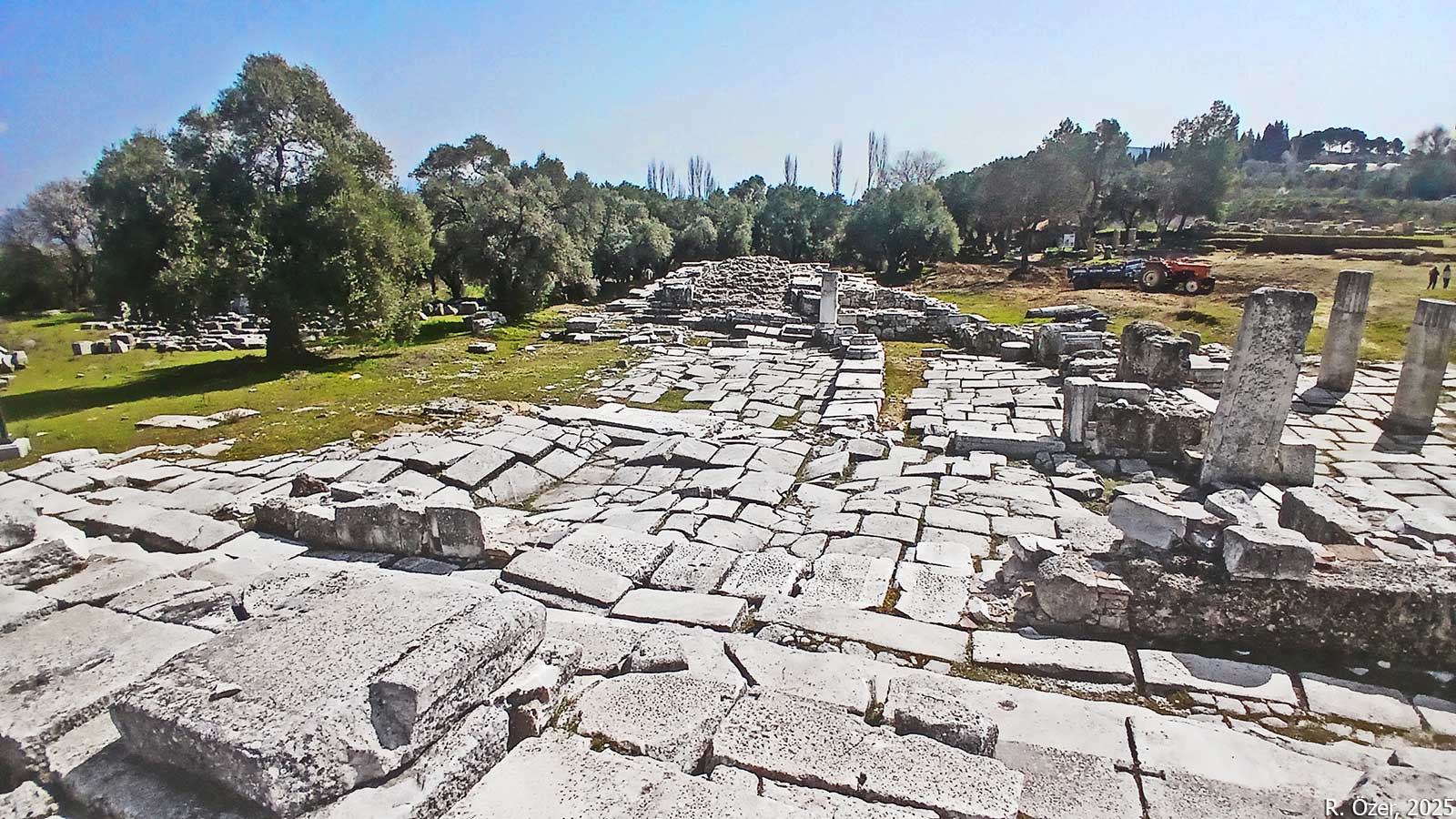
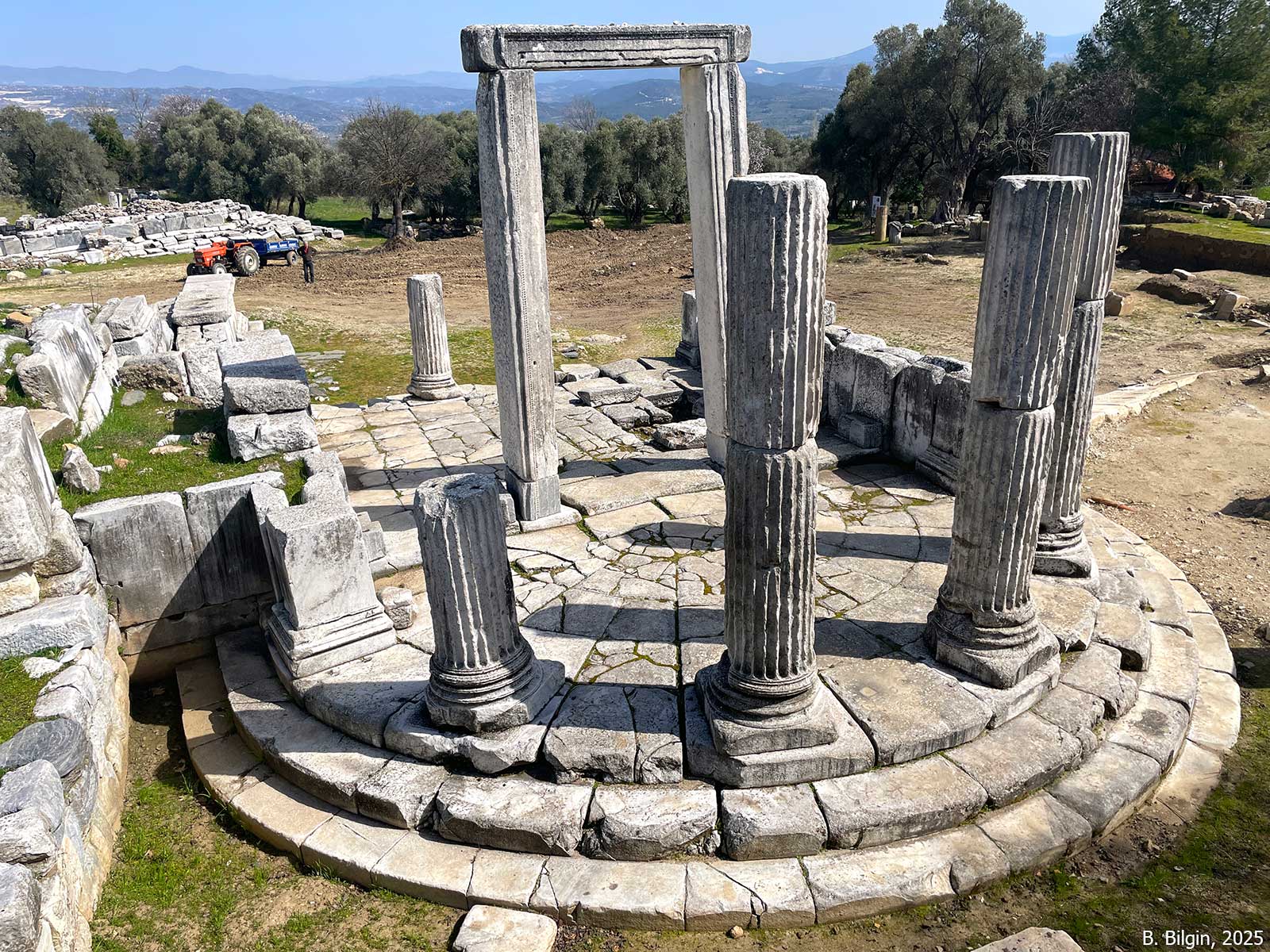
A semi-circular monumental gateway (propylon) provided access to the sanctuary. It featured Ionic columns and a unique plan blending apsidal and rectangular elements. The sanctuary was enclosed on four sides by Doric stoas during the Roman period, creating an enclosed, inward-facing precinct. A large u-shaped altar was located to the southeast of the temple, aligned with the temple’s entrance.




References:
Büyüközer, A. 2018. “The Sanctuary of Hekate at Lagina in the 4th Century BC,” Arkhaia Anatolika 1, 15–30.
Gider-Büyüközer, Z. 2020. “Lagina,” in The Carians, From Seafarers to City Builders, eds. O. J. Henry & A. Belgin-Henry, İstanbul, 124–139.
Herring, A. 2022. “Hekate of Lagina: A goddess performing her civic duty,” Anatolian Studies 72, 141–165.
Newton, C. T. 1863. A History of Discoveries at Halicarnassus, Knidos, and Branchidae I-II, London.
Pedersen, P. 2012. “Lagina and the Ionian Renaissance,” in Stratonikeia’dan Lagina’ya (Fs A. A. Tırpan), ed. B. Söğüt, İstanbul, pp. 513–525.
Söğüt, B. 2008–2021. Lagina Kazı, Koruma ve Onarım Çalışmaları https://www.pau.edu.tr/lagina
Tırpan, A. A., Z. Gider, & A. Büyüközer. 2012. “The Temple of Hekate at Lagina,” in Dipteros und Pseudodipteros: Bauhistorische und archäologische Forschungen BYZAS 12, İstanbul, 181–202.
Images:
C. T. Newton, 1863
A. Herring, 2022
Bora Bilgin, 2025
Tayfun Bilgin, 2025
Reha Özer, 2025