
The inscriptions from Iasos were discovered during Italian excavations directed by Doro Levi and later Fede Berti. Most of them are graffiti on pottery. With the exception of C.Ia 3, they are extremely short and mostly onomastic marks.
C.Ia 1
This graffito was found in 1962 in the excavations in front of the East Gate of Iasos. It is inscribed on the neck of a pink clay vase fragment and is currently kept in the Izmir Archaeological Museum (Inv. 494). The text is written from left to right (dextroverse) and consists of a brief onomastic sequence. Based on the museum’s inventory, the pottery is dated to the 8th or 7th century BCE.

(→)
1 […] la
2 limtaoa x
3 om
C.Ia 2
The graffito on a red polished pottery fragment (a local imitation of Samian ware) was discovered in 1962 in the quarter near the theater. It is housed in the Izmir Archaeological Museum (Inv. 309c). While traditionally included in the Carian corpus, recent scholars have questioned its Carian character due to the ambiguity of the signs. Archaeological context suggests it dates to a much later period than C.Ia 1.

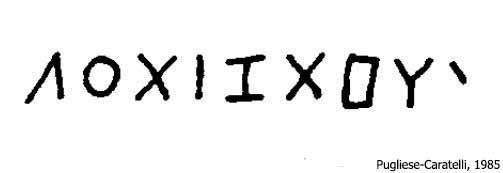
(←)
1 […]uek̑λ k̑ob[…]
C.Ia 3
This is the most significant inscription from Iasos, found in 1982 within a sacellum (small shrine) dedicated to a god and goddess in the Sanctuary of Zeus. It is engraved on the broad rim of a large Attic column crater decorated with black figures depicting a komos scene. The original vessel is kept in the Iasos Museum. The text is a votive dedication to the storm god Tarhunt (trquδe), possibly by an individual named Areš(?), son of Siyklo. The crater is dated stylistically to the last quarter of the 6th century BCE.


Adiego 2025:
(→)
1 […?] areš šanne mλne siykloś šann trquδe k̑λmuδ[-?]
C.Ia 4
This is the only Carian inscription from Iasos written on stone, discovered during regular excavations and kept in the Iasos Museum (Inv. 5479). It is a fragment of a local white limestone slab featuring five letters in what appear to be the left end of the bottom three lines of an inscription. Unlike the several other graffiti from Iasos, characters are inscribed evenly with precision, giving the impression that it might have served an official purpose. It may date to the 4th century BCE.

(→)
1 n[…]
2 pr[…]
3 is[…]
C.Ia 5
This graffito on a black-glazed skyphos fragment (3.2 x 3 cm, Inv. 6422) was found at the basilica near the East Gate. Although excavated in 1965, the inscription was noticed much later and published in 1998. It is kept at the Iasos Museum. It is archaeologically dated to the 5th century BCE.
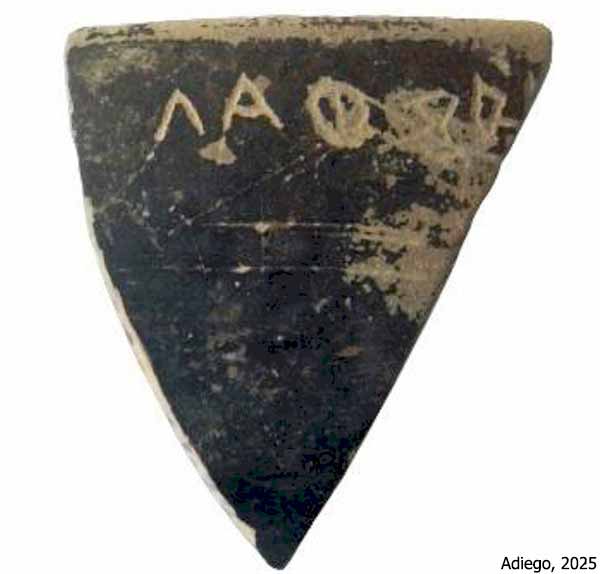

Adiego 2025:
(→)
1 baśγ?e?[…] (or: baśγ?k?[…], or: baśγ?ý?[…])
C.Ia 6
Also published in 1998, this inscription is on the base fragment of an Attic black-glazed cup (Inv. 2445) only about 2 x 4 cm. Although excavated in 1970, like C.Ia 5, the inscription was noticed much later and published in 1998. It dates to the last quarter of the 5th century BCE and is currently held at the Iasos Museum.


Adiego 2025:
(→)
1 […]ṃn?eś (or: […]ṃβ?eś)
C.Ia 7
Discovered in 1971 in the Area of Artemis Astias, this graffito is inscribed on the base of an Attic black-glazed stemless cup (Inv. 7402) and is currently kept in the Iasos Museum. It dates to the 4th or 3rd century BCE.


Adiego 2025:
(←)
]-?-dýnš
C.Ia fragments
Small fragments found (Inv. nos. 5785, 5896, 7094) in 1987 and 1997 bear only remains of single Carian characters. Fragments were found found with other Late Archaic material (the late 6th to early 5th century BCE).


no. 5785: j
no. 5896: y
no. 7094: γ
References:
Adiego, I.- J. 2007. The Carian Language, Leiden/Boston. (C.Ia 1–C.Ia 7)
Adiego, I.- X. 2019. “’Archaic’ Carian,” in Karia Arkhaia. La Carie, des origines à la période pré-hekatomnide. 4èmes Rencontres d’archéologie de l’IFÉA. Istanbul, 14-16 novembre 2013, eds. O. Henry, K. Konuk, Istanbul, 23–41.
Adiego, I.- X. 2025. “Carian epigraphy from Iasos,” Missione Archeologica Italiana di Iasos 9, 105-116.
Berti, F. & Innocente, L. 1998. “Due nuovi graffiti in alfabeto cario da Iasos,” in Colloquium Caricum, ed. W. Blümel, Berlin, 137–142.
Berti, F. 2021. “Iasos, nn. inv. 5896, 7094 (e 5785): una scheda e una domanda,” Iasos 27,11–13.
Innocente, L. 2019. “L’iscrizione C.Ia 4,” in Forme del Sacro. Scritti in memoria di Doro Levi, ed. F. Berti,109–110.
Levi, D. & Pugliese Carratelli, G. 1961-62[1963]. “Nuove Iscrizioni di Iasos,” Annuario della Scuola Archeologica di Atene 39–40, 573–632.
Pugliese Carratelli, G. 1985[86]. “Cari in Iasos,” Atti della Accademia Nazionale dei Lincei. Rendiconti 40, 149–155.
Images:
D. Levi & G. Pugliese Carratelli, 1961-62[1963]
G. Pugliese Carratelli, 1985[86]
F. Berti & L. Innocente, 1998
I.-X. Adiego, 2007, 2019, 2025
F. Berti, 2021 Tayfun Bilgin, 2026