C.Hy 1
This white marble stele was discovered in two stages at the village of Mesevle (ancient Hyllarima). The right-hand section was first found by Alfred Laumonier in 1933, and the missing left-hand portion was discovered in 2004. The two fragments fit together perfectly, forming a nearly complete stele (101 x 86 x 18 cm) —minus the lower section— and is now housed in Muğla Museum. The stele is inscribed on the front and both sides with a complex series of Carian and Greek inscriptions. It is considered the best-preserved long Carian inscription and functions as an official religious record. The Carian text on the top section of the front includes a heading and five onomastic formulas identifying local priests and is accompanied by a four-line Greek text. The other Greek texts on the lower section of the front and the two sides of the stele appear to be added at later dates and also concern a list of priests and land purchases. Adiego’s (2019) analysis indicates that the Carian text mentions (ll.1-2): “under the reign of Philip in the year four in the month of Tarhunt, priests for the gods of Hyllarima,” where Philip has been identified with Philip III of Macedon, thus dating the inscription to sometime in 323–317 BCE. The personal names in line 3 of the Carian text likely corresponds to the names mentioned in the accompanying Greek inscription. The continuing Carian names of priests are probably added in later stages.
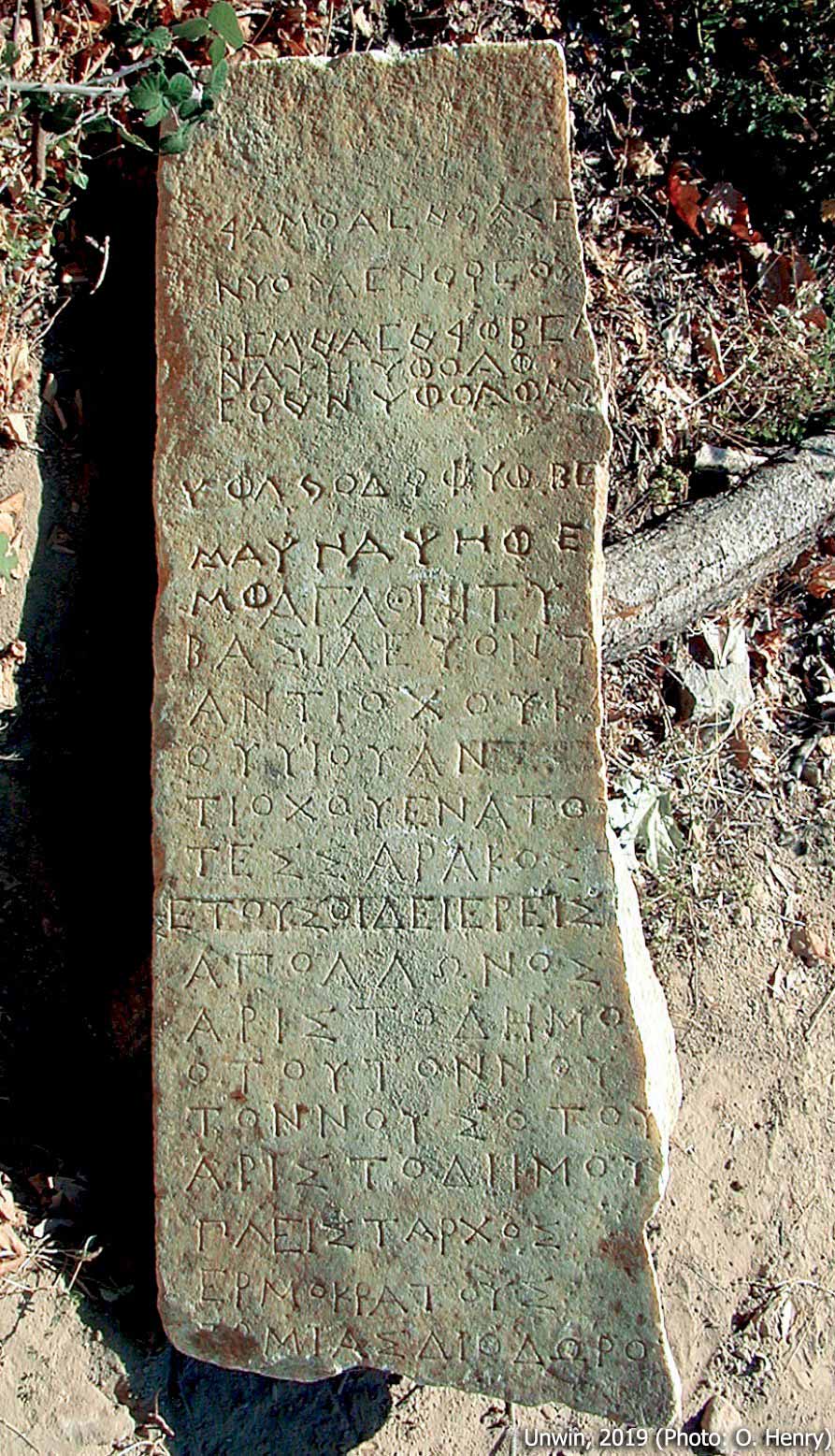


(→)
1 šasqarioδdymδa kδuśo pilipus usoτ
2 muoτ armo trqδos qmoλš msoτ yλarmiτ
3 βrsi arišś βrsiś
4 mane uśoλś
5 rtim uśoλś pur?iś
6 uśbloλ tñuś βrsiś
7 pau maneś
7-8 ybrsś
Greek text:
ΙΕΡΕΙΕΣ ΘΕΩΝ ΠΑΝΤΩΝ “Priests of all the gods,
ΕΡΜΙΑΣ ΦΑΝΕΩ ΕΡΜΙΑΔΟΣ Hermias (son of) Phanes (son of) Hermias,
ΙΕΡΕΥΣ ΘΕΩΝ ΠΑΝΤΩΝ priest of all the gods,
ΥΣΣΩΛΛΟΣ ΑΡΡΙΣΣΙΟΣ Hyssollos (son of) Arrissios.”
References:
Adiego, I.- J. 2007. The Carian Language, Leiden/Boston. (C.Hy 1)
Adiego, I.- X. 2019. “A Kingdom for a Carian Letter,” in Luwic Dialects and Anatolian. Inheritance and Diffusion, eds. I.-X. Adiego et al., Barcelona, 11–50.
Adiego, I.- X. 2020. “The beginning of the Carian inscription of Euromos C.Eu 2. A new reading and interpretation,” Kadmos 59, 129–143. (138–139)
Carless Unwin, N. 2019. “Multilingualism in Karia and the social dynamics of linguistic assimilation,” in Karia Arkhaia. La Carie, des origines à la période pré-hekatomnide. 4èmes Rencontres d’archéologie de l’IFÉA. Istanbul, 14-16 novembre 2013, eds. O. Henry, K. Konuk, Istanbul, 43–60. (60)
Laumonier, A. 1934. “Inscriptions de Carie,” Bulletin de Correspondance Hellénique 58, 291–380 (345–351).
Images:
A. Laumonier, 1934
L. Robert, 1950
N. Carless Unwin, 2019
I.- X. Adiego, 2020