C.xx 1
The engraved bronze phiale (a shallow votive bowl) measuring 4.6 cm in height and 11.5 cm in diameter is of unknown exact origin. It was acquired through the antiques trade but scholars have suggested it may originate from a sanctuary of the god Natr- (identified with Apollo), potentially in the region of Halicarnassus. The text is written from right-to-left on the inner rim. The word śrquq is interpreted as a personal name, while ntro refers to the deity (Apollo?) to whom the vessel was dedicated. It is dated to the 6th century BCE based on its archaic paleography and the style of the bronze vessel. Currently it is housed at the Michael C. Carlos Museum of the Emory University (Obj. No. 2000.001.004).

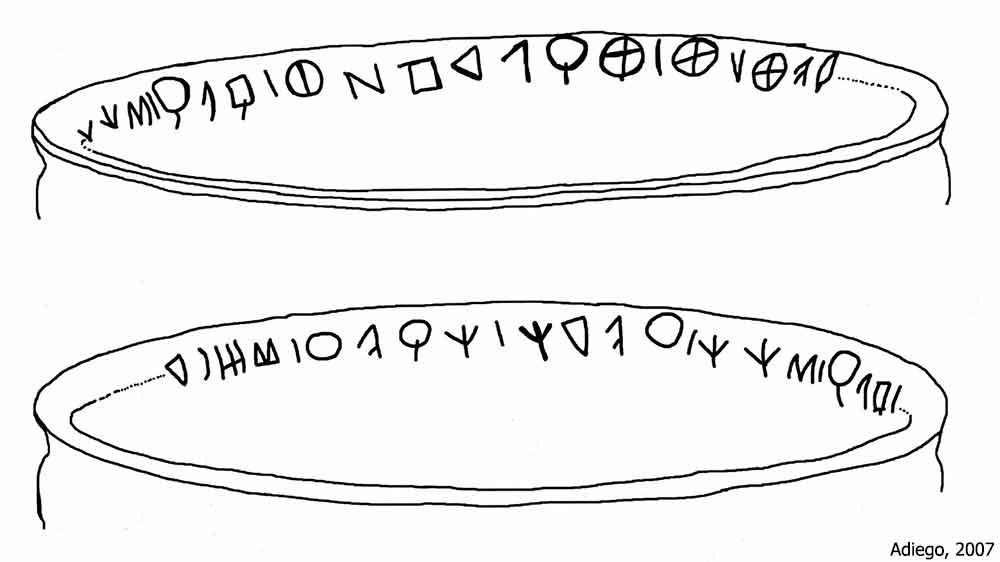
(←)
1 šrquq qtblemś ýbt snn orkn ntro pjdl?
C.xx 2
The exact find spot of the large bronze dinos (a deep mixing bowl) measuring 33 cm in height and 30.5 cm in diameter is unknown, but it is presumed to come from Caria. It is believed to belong to the same group of votive objects as C.xx 1 and C.Ha 1, likely originating from a common Carian sanctuary, possibly at Halicarnassus. The inscription incised on the rim is highly significant for the sequence alosd k̑arnosd, which has been associated with the Carian name for the city of Halicarnassus (Greek Alikarnassos). It is dated to the 6th century BCE. At the time of the publication of Gusmani in 1978, the vessel was held as a loan at the Badisches Landesmuseum in Karlsruhe, Germany.

(→)
1 ýśbiks not alosδ k̑arnosδ jzpe mδane
C.xx 3
This object appeared in the European antiques trade around 1987 with an unidentified origin. It is suspected to have been stolen from a Carian sanctuary approximately fifteen years prior to its publication in 1994. The text is inscribed on the bronze cult object described as an assommoir—a ritual hammer or tool used for animal sacrifices. The inscription is written from right to left and consists of a single continuous sequence. The text is notably difficult to analyze due to an unusually high concentration of vowel signs for Carian. It is dated between 650 and 550 BCE. The item was sold at auction at Christie’s London in 2012 and its current whereabouts are unknown.
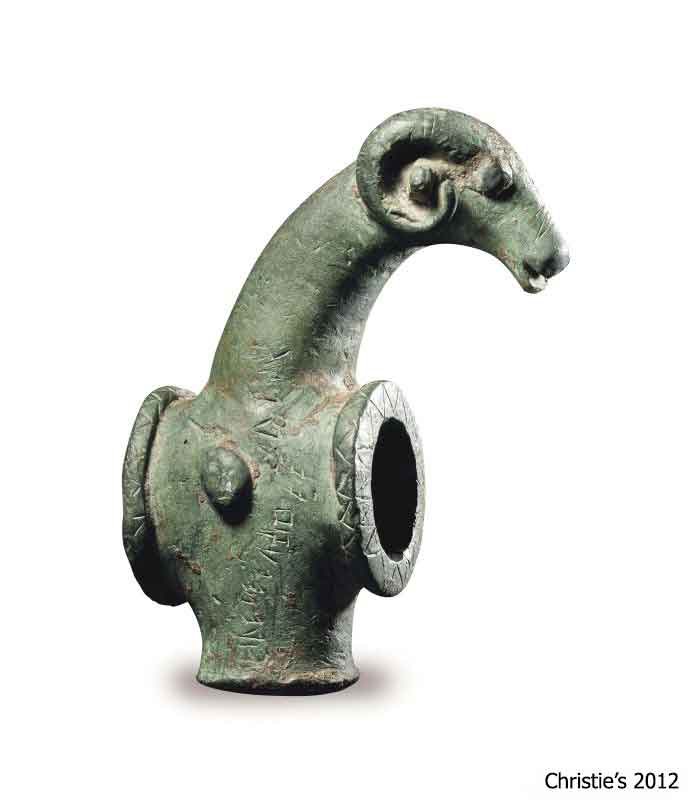


(←)
1 akymyδuýeryl{}?d
C.xx 4–5
These two identical inscriptions were found on a pair of silver bracelets that arrived as a gift to a museum in Munich. They are small, with an inner diameter of 38–39 mm, suggesting they were either jewelry for a child or votive offerings. The single word on them is interpreted as a personal name. Paleographically, the letter ś provides a manifest connection to the Kaunian alphabetic variant. They are attributed to the 4th or 3rd century BCE, and are housed in the Archäologische Staatssammlung in Munich (Inv. No. 1985,1090).

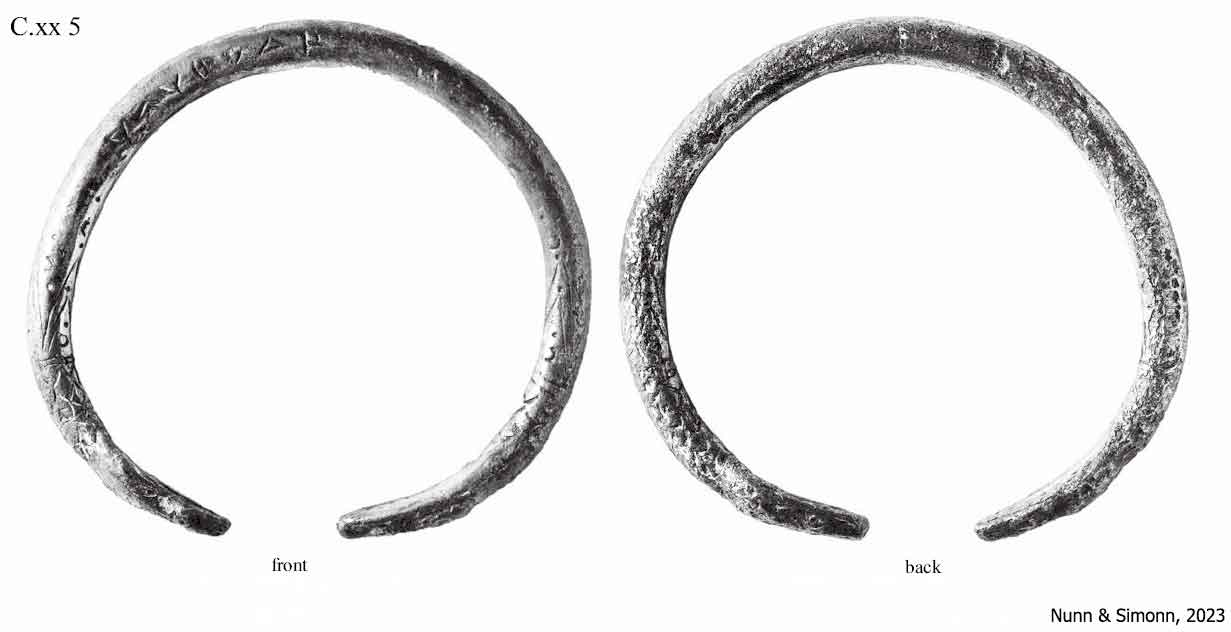

(→)
1 kδuśolš
References:
Adiego, I.- J. 2007. The Carian Language, Leiden/Boston. (C.xx 1–C.xx 5)
Adiego, I.- X. 2019. “’Archaic’ Carian,” in Karia Arkhaia. La Carie, des origines à la période pré-hekatomnide. 4èmes Rencontres d’archéologie de l’IFÉA. Istanbul, 14-16 novembre 2013, eds. O. Henry, K. Konuk, Istanbul, 23–41. (31–33)
Gusmani, R. 1978. “Zwei neue Gefässinschriften in karischer Sprache,” Kadmos 17, 67–75.
Meier-Brugger, M. 1994. “Ein neuer Blick nach zehn Jahren,” in Decifrazione del cario, ed. M. E. Giannotta et al., Roma, 111–114.
Nunn, A. & Simon, Z. 2023. “Zwei Armreife mit karischer Inschrift aus der Archäologischen Staatsammlung in München,” in The Persian World and Beyond, eds. M. B. Garrison & W. F. M. Henkelman, Münster, 165–176.
Schürr, D. 2001. “Zur karischen Inschrift auf dem Genfer Kultgegenstand,” Kadmos 40, 117–126.
Schürr, D. 2010. “Rezension von The Carian Language by I.-J. Adiego,” Kratylos 55, 134–142.
Zahlhaas, G. & Neumann, G. 1994. “Zwei neue karische Inschriften aus München,” Kadmos 33, 160–168.
Images:
G. Zahlhaas & G. Neumann, 1994
I.- J. Adiego, 2007
Christie’s 2012 (Accessed 2026-05-06)
A. Nunn & Z. Simon, 2023
Michael Carlos Museum (Accessed 2026-05-06)