The Carian inscriptions from Memphis and Saqqâra consists almost entirely of funerary steles bearing incised inscriptions beloning to the Carian mercenaries, who were employed by the pharaohs, starting with Psamtik (Psammethicus) I in the 7th century BCE as mentioned by Herodotus (Herodotus I, 151). The stelea and the few other objects of funerary nature must have originated from one or more Carian cemeteries once existed in the vicinity of Memphis, in connection with the Carian quarter—or Karikon—mentioned in certain Greek sources. At a later period when the cemeteries had fallen into disuse, these objects must have been looted for construction material. E.Me 9–64 were found in the first few years of the excavations conducted between 1968 and 1975 in the underground galleries of North Saqqâra by the Egypt Exploration Society, apparently all in secondary context.
E.Me 1
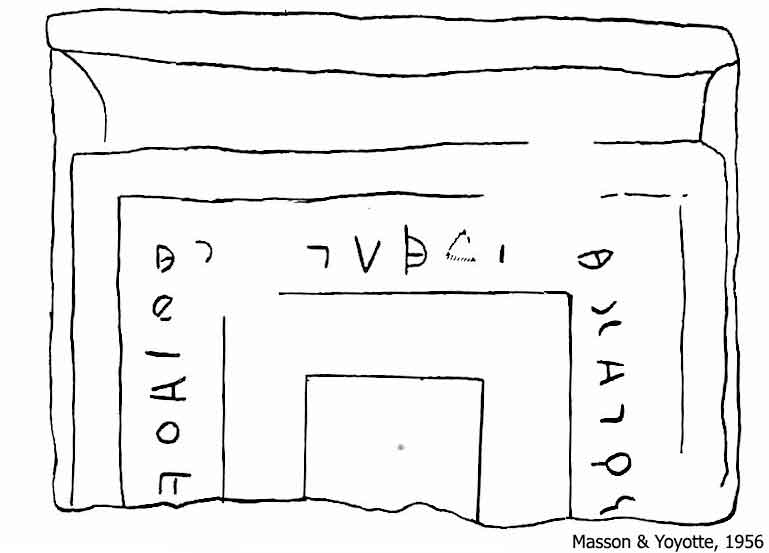
The inscription is written on a false-door stele (12 x 17 x 7 cm) which likely to have originated from a necropolis in Memphis. The right-to-left-written text is an onomastic formula with multiple names. Only the top section of the limestone stele is preserved and currently in the collection of the Louvre Museum (AO 4445).


(←)
1 ttbazi[ś] p̣iub[a]ẓiś aor[ś]
E.Me 2
The two-line inscription is written on a false-door shaped stele made of limestone (34 x 19 x 5 cm). It is written right-to-left on the top frames of the ‘door.’ The stele is believed to have originated from a necropolis in Saqqâra and currently in the collection of the Louvre Museum (AO 1477).


(←)
1 uksmu lkorś
2 mrsiś
E.Me 3
The two line inscription is written right-to-left on a round-topped limestone stele (33 x 29.5 x 5 cm). It is an onomastic formula with multiple names that might be read: “This (is) of Pikre (son?) of Šarwljat ….” It was acquired from the antiquities market in 1905 and today is in the Royal Museums of Art and History in Brussels (Musées royaux d’Art et d’Histoire, inv. no E.2483).


(←)
1 pikreś ue
2 šarwljatś msnordś
E.Me 4
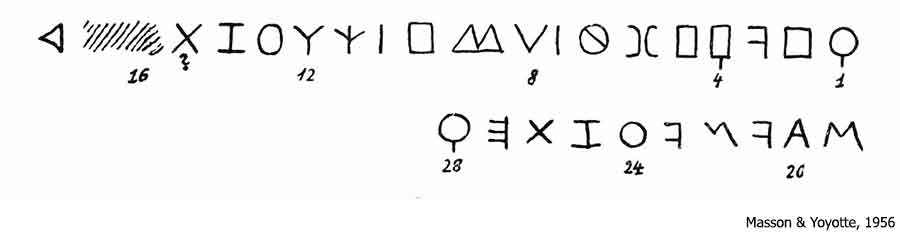
The round topped stele of coarse limestone (h. 27 x w. 21 cm) was found by Maspero in the mid 19th century somewhere around Serapeum in Saqqâra. The Carian inscription is carved on the right and top border from bottom-up and right-to-left. The first two words are analyzed as “Stele of Terýez ..”. The hieroglyphic text names Pharaoh Apries (589–570 BCE), which indicates it to be a donation stele. Whether the Carian inscription is contemporary with the stele is uncertain. It is in the possession of the Cairo Museum (E49060).


(←)
1 terýezś upe nuoλḳ̑[…]
2 sarmroλk̑yt
E.Me 5
The rectangular stele of limestone (h. 59 x w. 36 cm) was first published in 1868, reportedly found in Serapeum in Saqqâra. The Carian inscription that starts as “This (is the stele) of Psmškwneit, (son?) of Naria-,“ is carved on the right edge from top down and right-to-left. The inscription appear to be bilingual as the same name is also mentioned in the hieroglyphic text (Psmtk-‘wj-Njt, literally meaning “Psamtik in the arms of Neith”). The stele has been dated to the end of the Saite period (mid to late-6th century BCE). It is currently in the Musée cantonal d’archéologie et d’histoire in Lausanne (Inv. 4727?).


(←)
1 psmškwneitś ue nariaś
2 śuγλi =q sarl
E.Me 6
The round-topped limestone stele (73.5 x 31.2 x 4.6 cm) was found mid-19th century probably at Serapeum in Saqqâra. The Carian inscription carved right-to-left in two lines on the lower section mention “Triqo son of Parmaś …”. Since the names do not correspond to those in the Egyptian inscription (“Petiese, son of Tetosire”), this is either a repurposed stele, or perhaps more likely, the two inscriptions reflect the Carian and Egyptian names of the same person whose father is a Carian, Parma, and mother is an Egyptian named Tetosire. The stele has been dated to the second half of the 6th century and currently in the Nicholson Collection of the University of Sydney’s Chau Chak Wing Museum (NMR.1141).


(←)
1 triqo parmaśś k̑i
2 kloruλ k̑i
E.Me 7
The round-topped limestone stele (43 x 31cm) was purchased by Borchardt in 1911 and is believed to originate from Saqqâra. Stylistically it appears to be contemporary with E.Me 6, thus probably date to the end of the Saite dynasty. The text is bilingual, as the names in the Carian inscription, “τamou (son) of τanaiś,” apparently correspond to the ones in the Egyption text. The stele is dated to the 6th century BCE. The stele was reported to be in Ägyptisches Museum in Berlin (21615), but was not located in recent searches.


(←)
1 τamou τanaiś qarsio[…]
E.Me 8
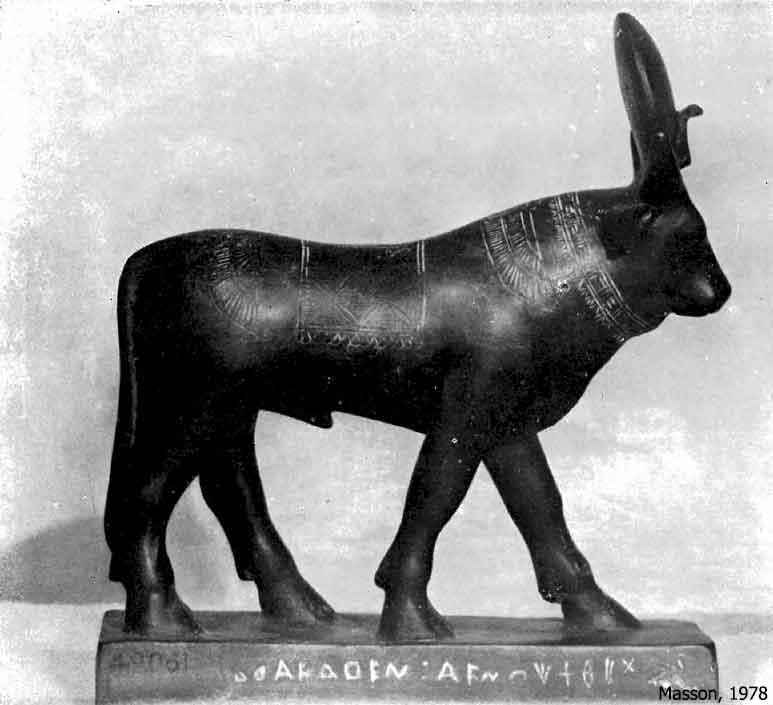
The bronze statuette depicting the sacred Apis bull (17.5 x 17.5 x 5 cm) was found in the mid-19th century in Sarapeum at Saqqâra. The Carian inscription is on the two long sides of the base. The front of the base has an Egyptian inscription that is read as “Apis may give life to Prjm the dragoman,” where Prjm is identified with the Paraeym of the Carian inscription. The statuette is dated to the 6th century BCE and in the inventory of the Cairo Museum (E49061).



(→)
a paraeym armon k̑i
b para!eym sb polo
E.Me 9
The upper part of a round-topped limestone stele (42 x 31 x 8.5 cm) was found in the 1968-69 season. The two-line carian inscription is written below a single line Egyptian. It may be read “the stele of Arliš, (son) of Arliom …”. The personal names correspond to the ones mentioned in the Egyptian line (“Jrš(3) son of Jrym3”). The stele was kept in storage in Saqqâra.

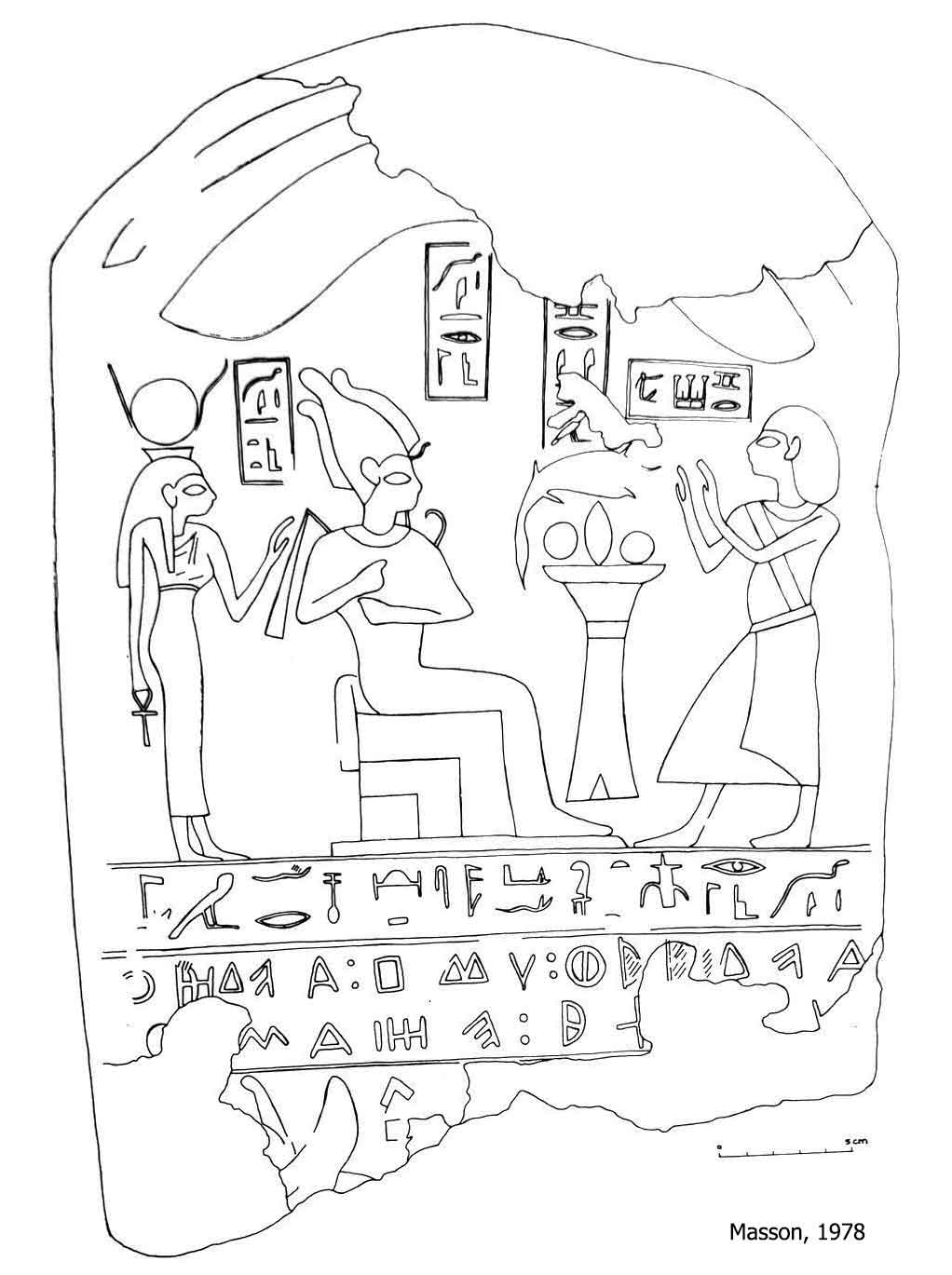
(←)
1 arlišś upe
1-2 arlio[mś]
2 k̑i yjas[iś]
E.Me 10
Two fragments and that belong to the lower section of a large stele were found between 1969 and 1973. They have a combined width of 26 cm and max height of 20 cm. They bear the remains of a two-line Egyptian and two-line Carian inscription. Stylistically it has been dated to the late 6th or 5th century BCE. It has been suggested that the Egyption text has been left unfinished (with no personal names) and the Carian had been added later. The latter appear to be an onomastic formula with multiple names. The fragments were kept in storage in Saqqâra.

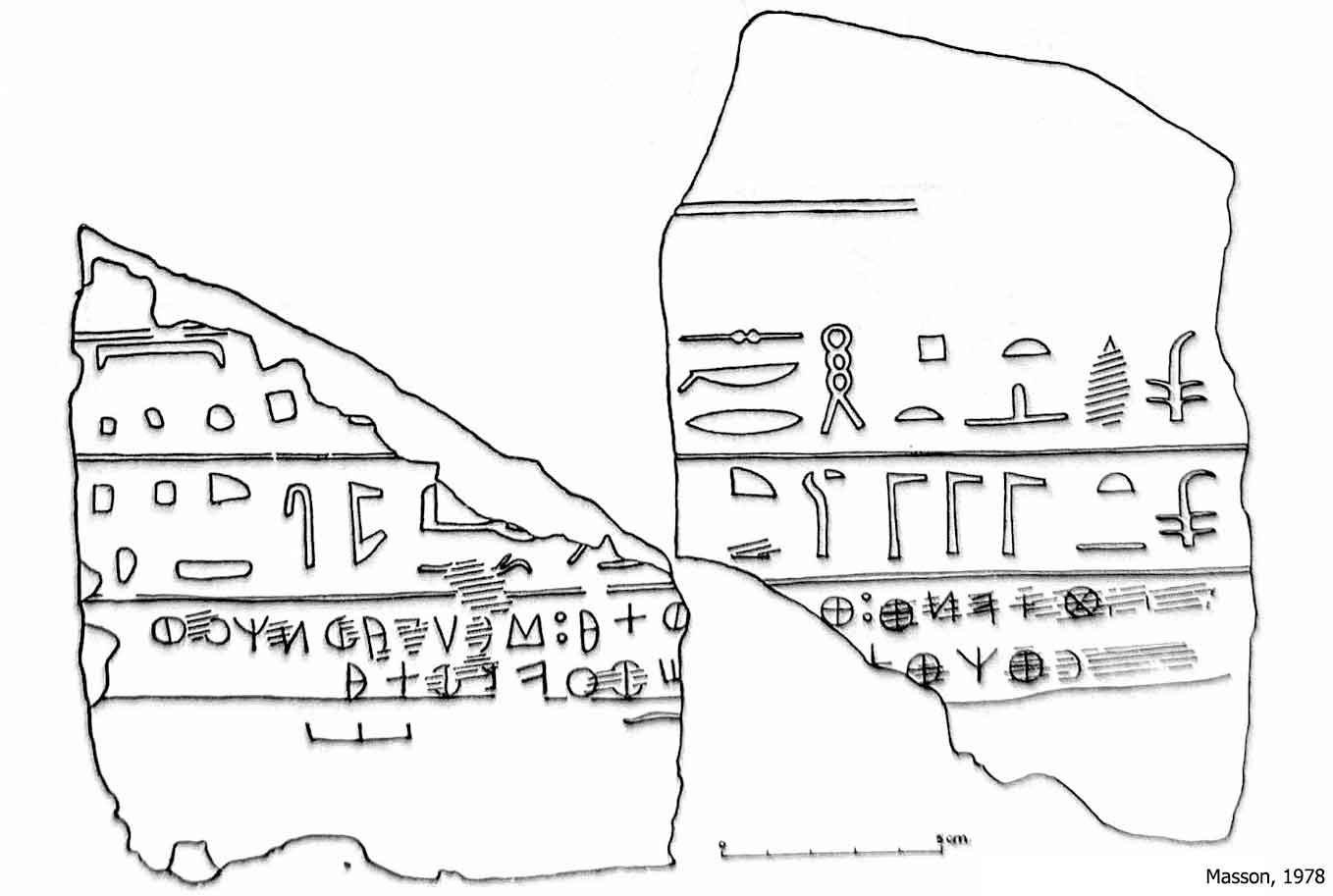
(←)
1 […]q̣ạrmś q[…]ś k̑i pḍuḅiś
2 mnoś [mw]donś k̑[i] […]wśordś k̑i
E.Me 11
The round-topped tall limestone stele (91.2 x 37 x 8 cm) was found in the 1968-69 season. The Carian text is incised two separate lines behind each standing figure running from bottom to top, parallel to the long sides. Largely unreadable, both lines are likely onomastic formulas representing each person, ending with the word mdaýn, which might be an ethnicon. Stylistically it has been dated to the mid-6th century BCE and currently is in the Fitzwilliam Museum in Cambridge, England (E.1.1971).


(→)
a wạr[…]t[…]i[…]ś mdaýn
b […]a[-]iś mdaýn
E.Me 12
The round-topped limestone stele (63 x 31x 9 cm) was found in two pieces in the 1968-69 excavation season. On the horizontal bar separating the top two registers is carved a single-line Carian inscription, ending of which continues vertically on the side border. It is likely an onomastic formula with multiple names. On account of the depiction, the deceased, Pjabrm, is believed to be a female. Stylistically it has been dated to towards the end of the 6th century BCE. The stele is in the British Museum (EA67235).


(→)
1 pjabrm wśoλś mwdonś k̑i kbjomś m[noś]
E.Me 13
The round-topped limestone stele (60 x 32 x 6.4 cm) was found in the 1968-69 season of excavations. A single-line Carian inscription is carved on the horizontal bar separating the second and third registers, where the last two characters curve upwards at the right end. It is likely an onomastic formula with multiple names. On account of the depiction, the deceased, Šdτat, is believed to be a female. Stylistically it has been dated to towards the end of the 6th century BCE. The stele was kept in storage in Saqqâra.
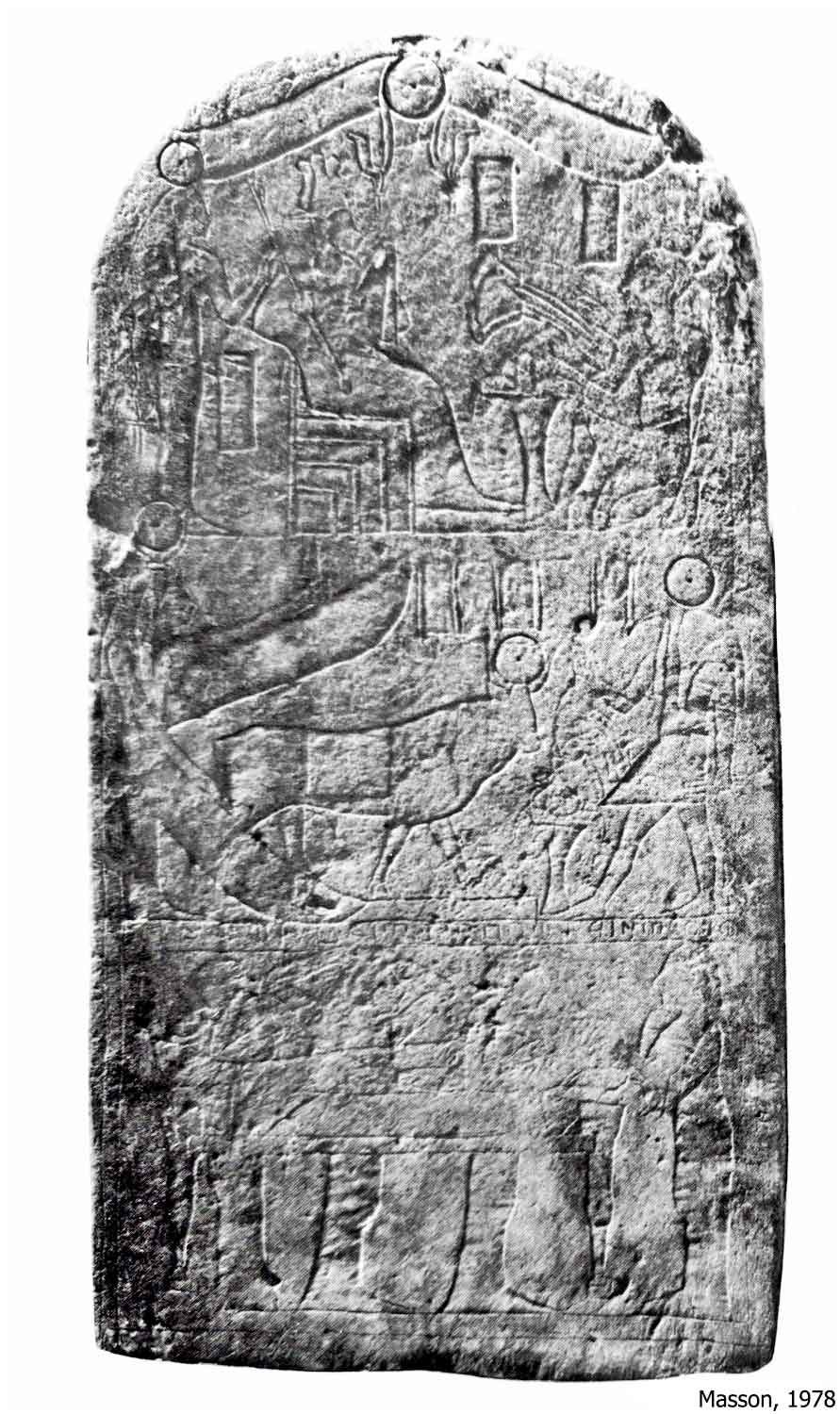

(→)
1 šdτatś upa w wetś k̑i mwdonś k̑i
E.Me 14
The round-topped limestone stele (47.6 x 26.5 x 6 cm) was found in the 1968-69 season of excavations. A single-line Carian inscription is carved on the horizontal bar separating the two registers, where the last few characters curve downwards at the right end. It is likely an onomastic formula with multiple names. Stylistically it has been dated to towards the end of the 6th century BCE. The stele was kept in storage in Saqqâra.


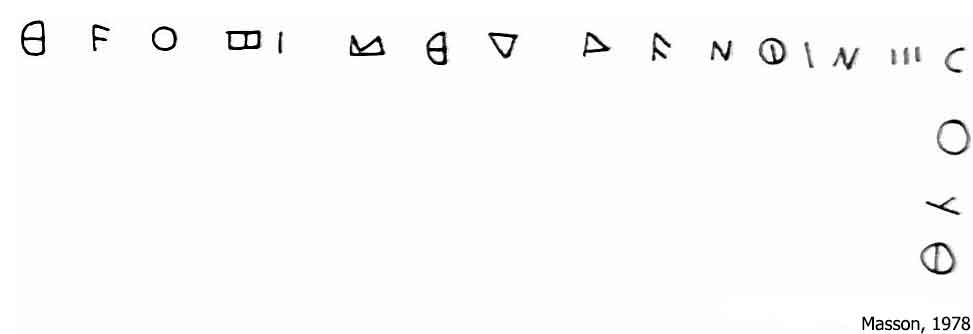
(→)
1 irow pikarmś mwdon!ś
E.Me 15
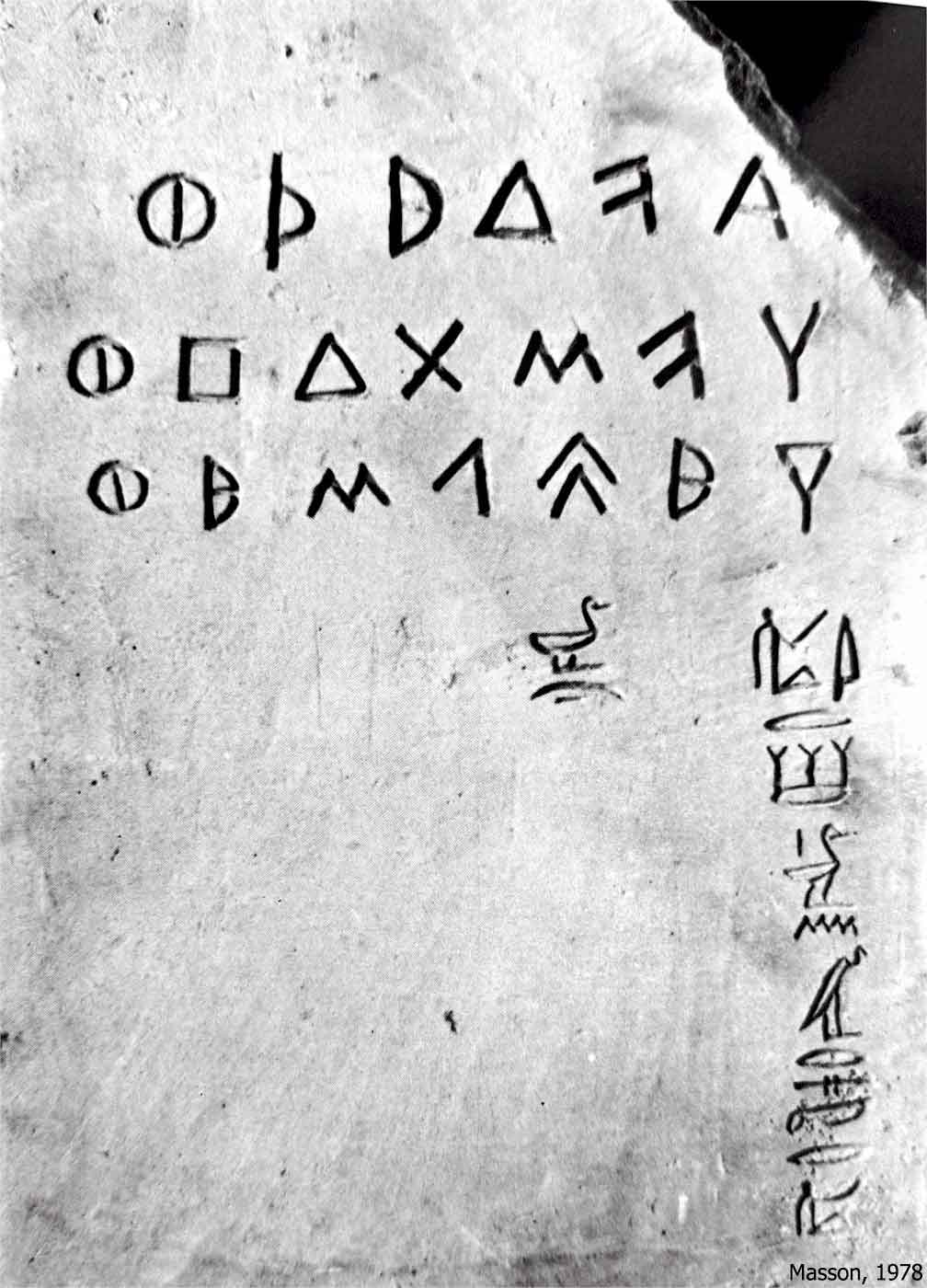
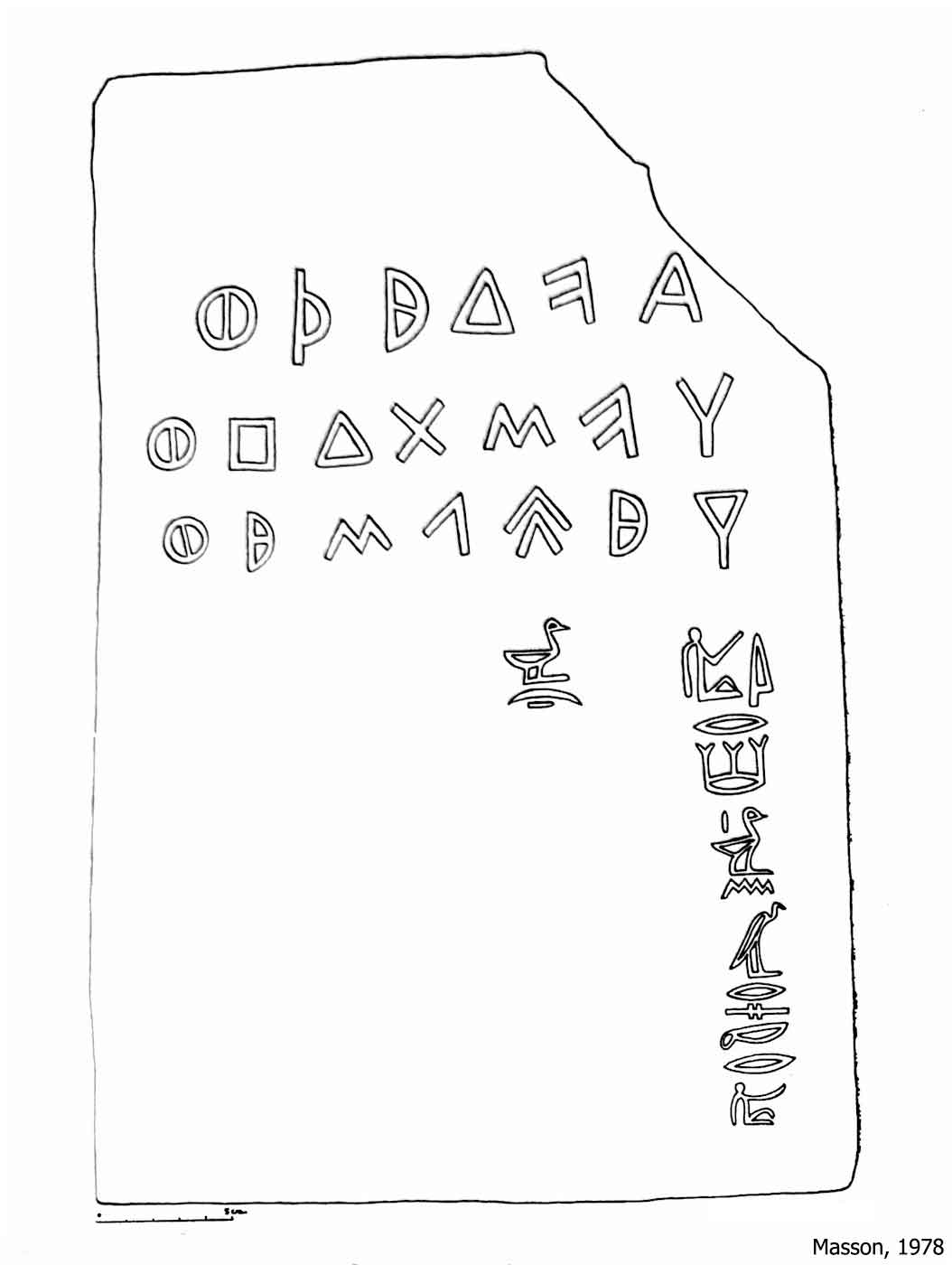
The simple rectangular limestone stele (43.2 x 29 x 7 cm) was found in the 1968-69 season. It featurs three horizontal lines of Carian script at the top—incised from right to left—and, beneath them, two columns of hieroglyphs, the left-hand column of which is visibly unfinished. The text appear to be bilingual since the personel names in the Carian text (“Arliš (son) of Ursk̑le…”) seem to correspond to the ones in the Egyptian line (“Jrš(3) son of 3rskr son of J’ḥ(?)-”). The stele is in the inventory of the Cairo Museum (JdE 91387).
(←)
1 arlišś
2 ursk̑leś
3 kiδbsiś
E.Me 16
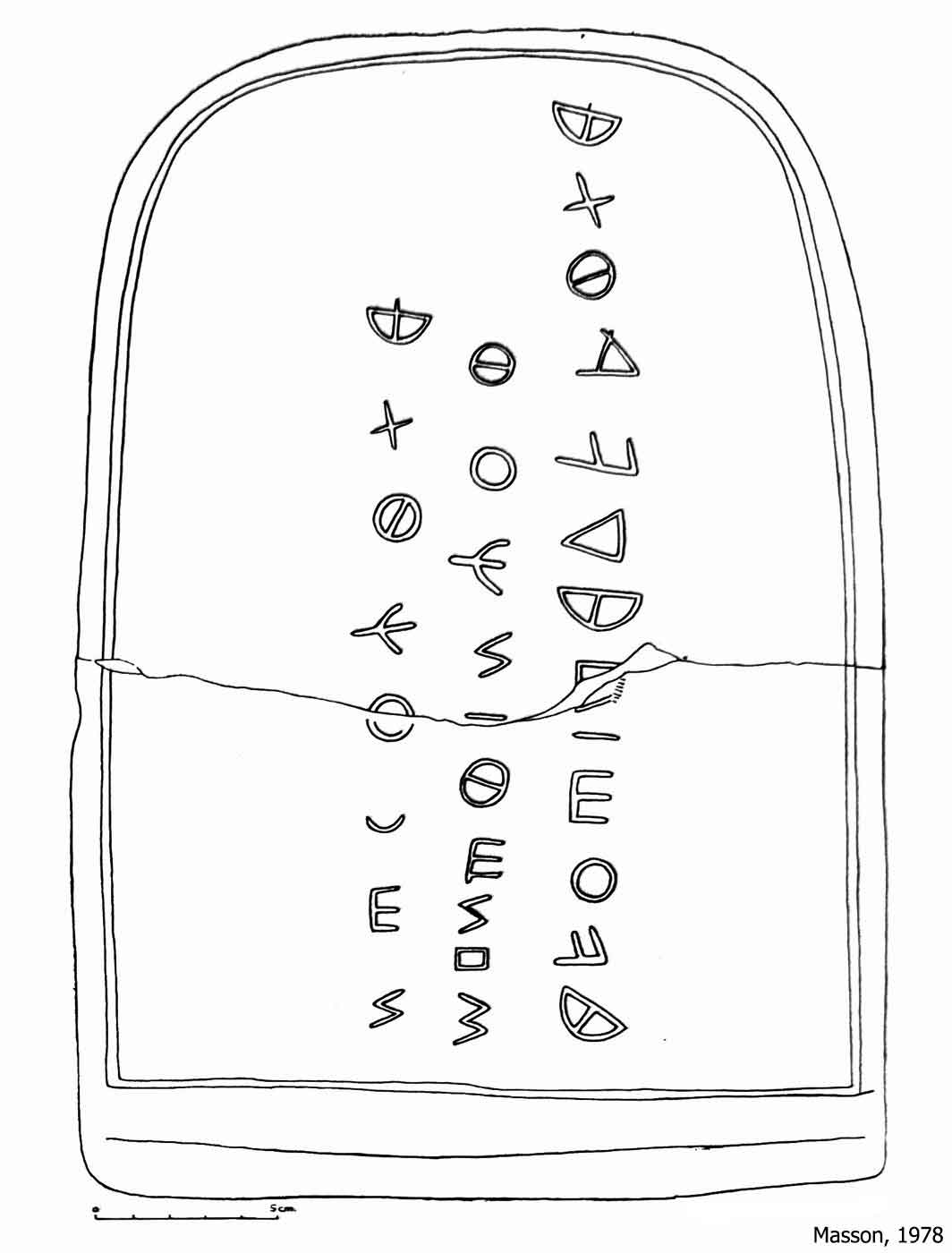
The undecorated round-topped limestone stele (33.5 x 16 x 4.8 cm) was found in the 1968-69 season. It is crudely carved with three lines of Carian inscription running vertically from bottom up and sinistroverse. It features an onomastic formula with multiple names. The stele is in the inventory of the Cairo Museum (JdE 91386).

(←)
1 irow pikraś k̑i
2 semwś mnoś
3 mwdonś k̑i
E.Me 17
The plain, round-topped limestone stele (33.8 x 22.8 x 7.8 cm) was found in the 1968-69 season. The inscription is arranged horizontally, in four lines incised from right to left. It features an onomastic formula with multiple names (“Stele of Šarnai (…) of Quq (…) of βem, …”). The stele is in the inventory of the British Museum (EA67236).


(←)
1 šarnaiś
2 upe quqś
3 βemś k̑i
3-4 mdaýn
E.Me 18
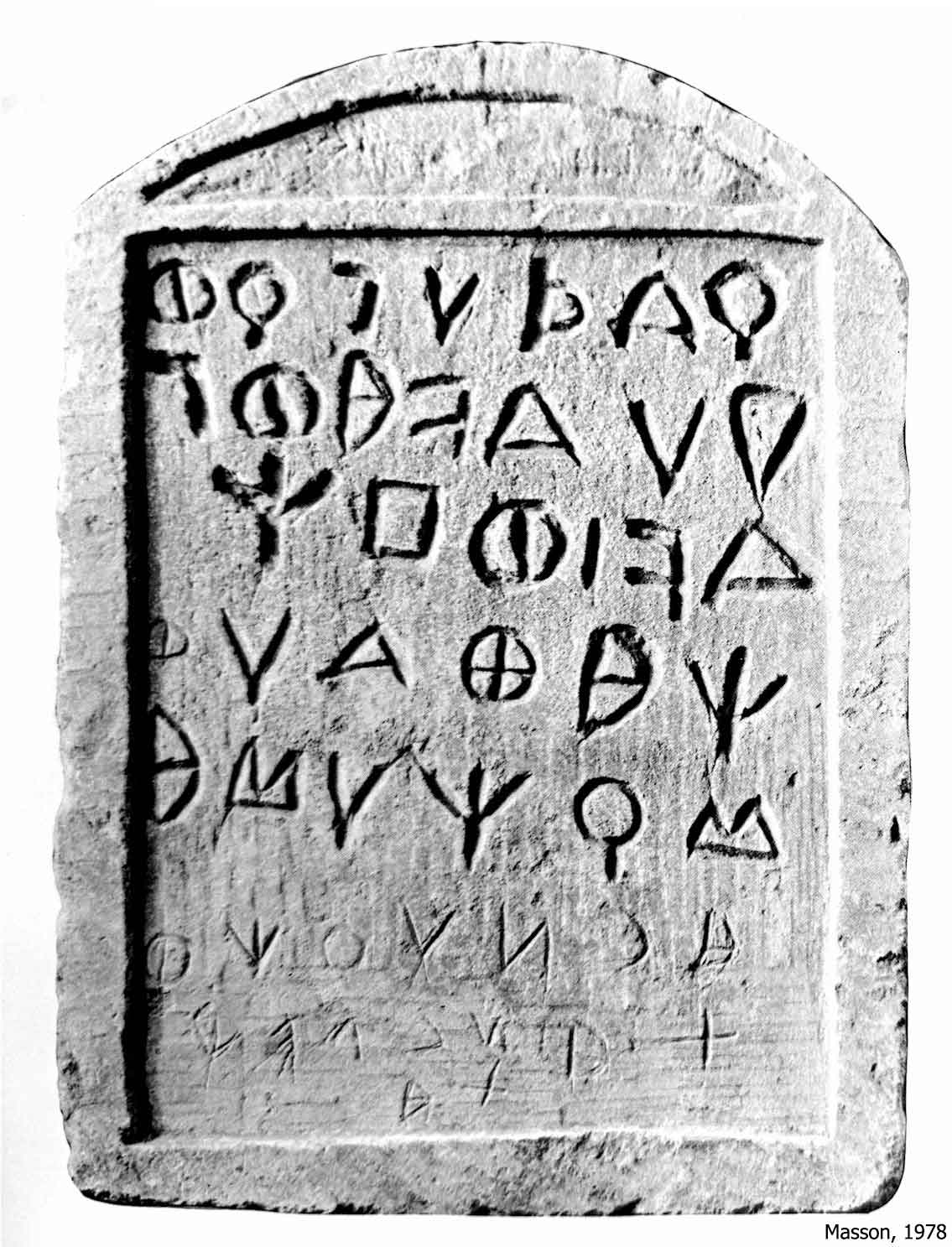
The round topped limestone stele (35.5 x 22.8 x 6 cm) with a border and a recessed pediment was found in the 1968-69 season. The top 5 lines of the inscription (a) is carved deeply with large letters. They feature onomastic formulas with multiple names. The bottom three lines (b) appear to be added later with smaller letters into the remaining space. The stele is in the inventory of the Cairo Museum (JdE 91385).

(←)
a1 tašubtś
a2-3 kuariśbar
a3 śen
a4 niqauś
a5 ptnupi
b1 idmuonś
b2 k̑i mdayn
b3 k̑i
E.Me 19
The plain limestone stele with a round-top (30.8 x 21 x 11.4 cm) was found in the 1968-69 season. The two-line inscription runs from right-to-left, “Pnuśoλ (son?) of Zmu.” The stele is in the Petrie Museum of University College London (LDUCE-UC2405).


(←)
1 pnuśoλ
2 zmuś k̑i
E.Me 20
The false-door type limestone funerary stele (29.1 x 19.6 x 7 cm) was found in the 1968-69 season. The inscription is arranged along the outer frame, from right to left, “Uqsi (son?) of Šrwli, ….” The word mwdon, also attested on several other steles, might be a title or profession, for which Simon (2021) suggests ‘mercenary’. The stele is in the inventory of the Cairo Museum (JdE 91384).


(←)
1 uqsi šrwliś k̑i mwdonś k̑i
E.Me 21
The false-door type rectangular limestone stele (33 x 21.6 x 7.6 cm) was found in the 1968-69 season. The text is arranged on two lines: within the outer frame, then within the inner frame, both from right-to-left starting at the top right corner. The first line might be read “(The stele) of Punwśoλ (son?) of Somne.” It is speculated that qýblsiś in the second line might mean ‘of Kyblissos’ which is a location in Caria. The stele is in the inventory of the Cairo Museum (JdE 91373).
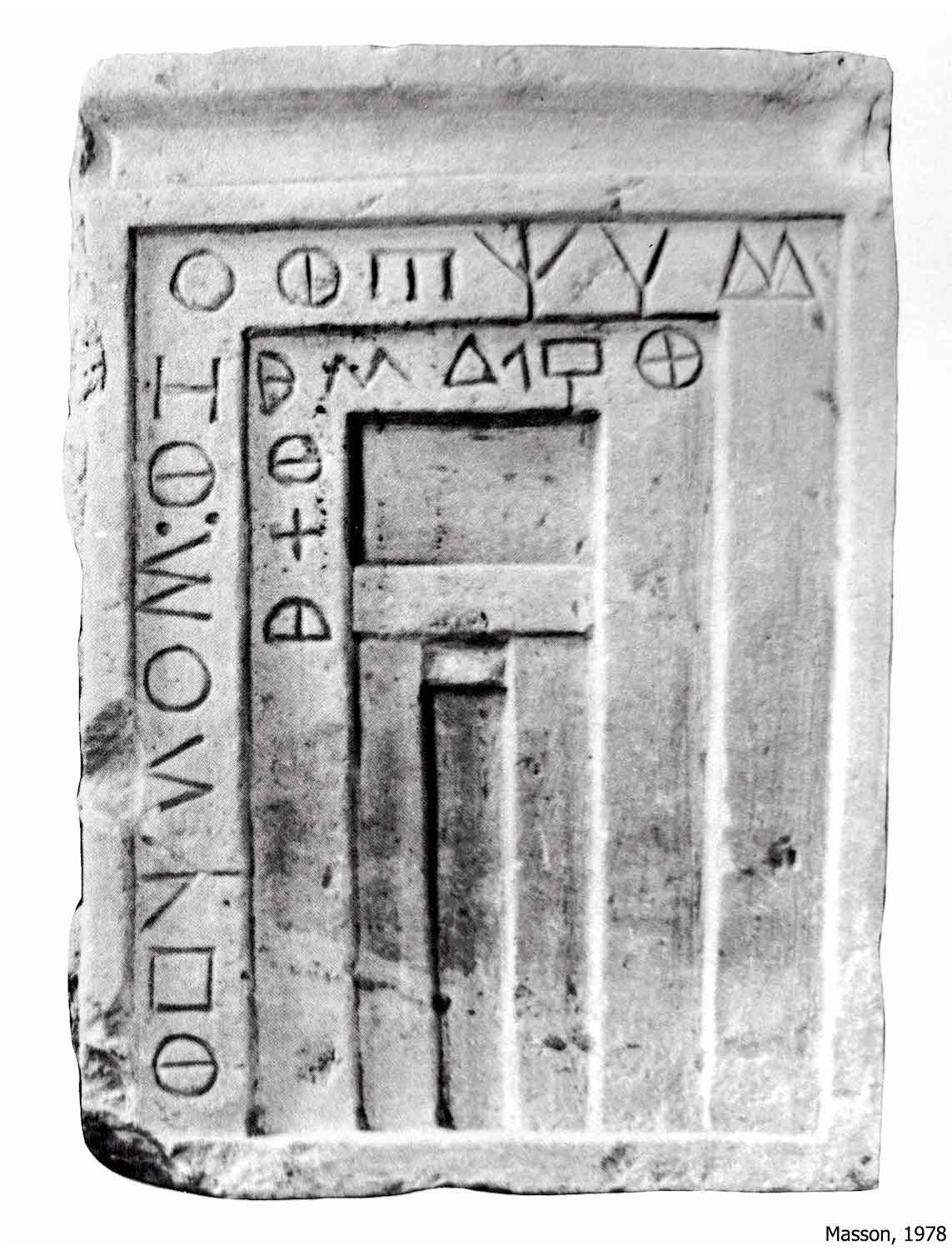

(←)
1 punwśoλś somneś
2 qýblsiś k̑i
E.Me 22
The false-door type rectangular limestone stele (42.5 x 20.5 x 7.3 cm) was found broken in two pieces in the 1968-69 season. The right-to-left-written single-line text on the upper frame, “The stele of Artay[…],” is missing the ending that must have continued on the damaged left side. The stele is in the inventory of Fitzwilliam Museum in Cambridge, England (E.3.1971).

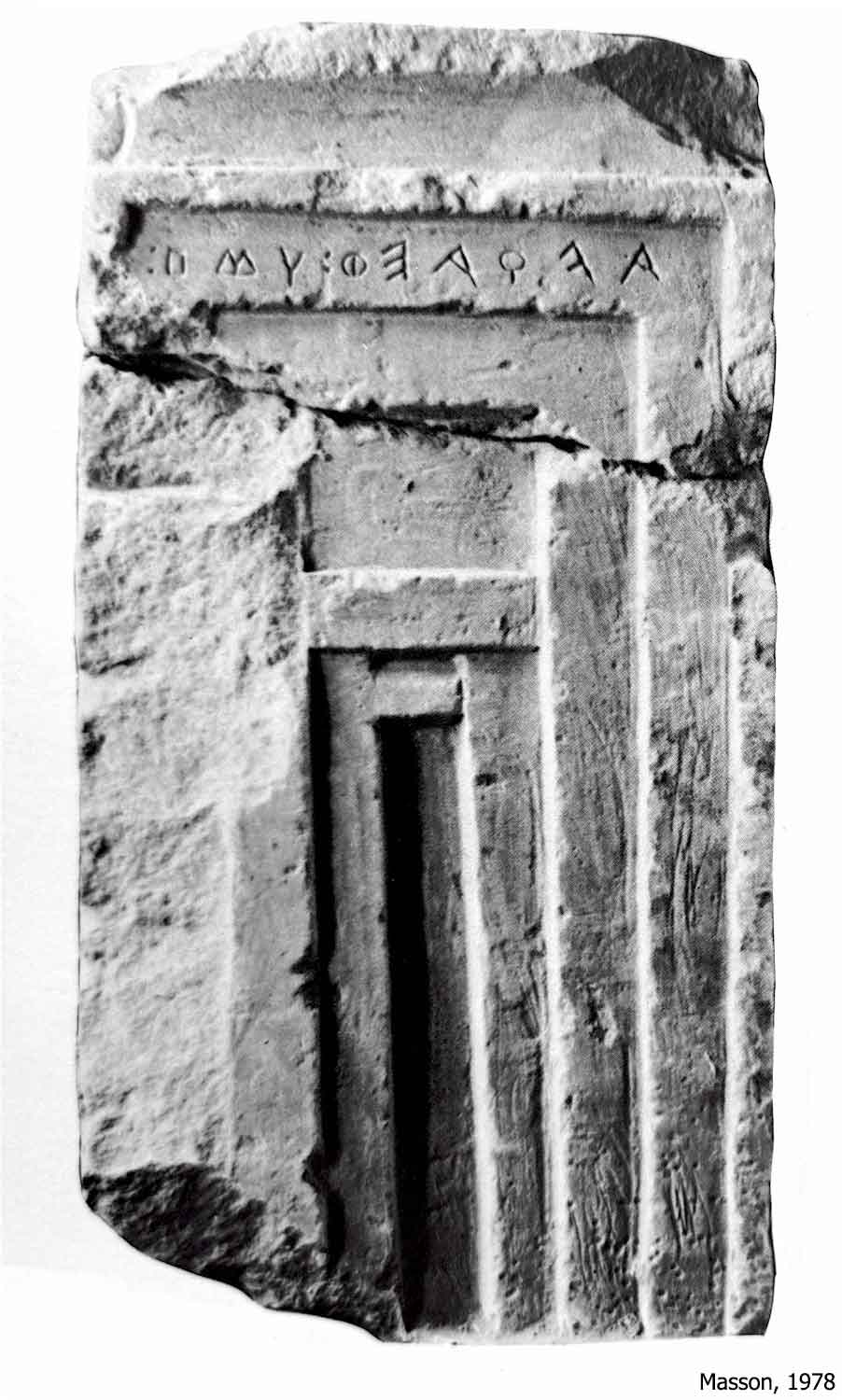

(←)
1 artayś upe […]
E.Me 23
The damaged limestone stele of false-door type (33.8 x 18.5 x 6 cm) was found in the 1968-69 season. The both lines of text, first one on the cornice and the second on the outer frame, are written left-to-right. The ending of the second line curves downward on the right. The stele is in the inventory of the British Museum (EA67251).


(→)
1 ap[…]ws
2 a[rb]ikarmś k̑i
E.Me 24
The limestone stele of false-door type (36.2 x 20 x 6 cm) was found in the 1968-69 season. The two-line text written on the cornice and the top frame. The second line continues on the right side of the frame, ending of which have been lost with the missing lower section of the stele. While the first word is likely to be the name of the deceased (Tduśoλ), kbo might be a title or an ethnic attribute. The stele (with a restored lower section) is in the inventory of Fitzwilliam Museum in Cambridge, England (E.2.1971).


(→)
1 tduśoλ
2 kbos šamsqi[…]
E.Me 25
The limestone stele of false-door type (32.3 x 21.5 x 7.3 cm) was found in the 1968-69 season. The stele is damaged on the mid-section of the right side, although inscription seem to be intact. It is written right-to-left on the cornice and the left frame and than continues on the right frame from bottom up in the right-to-left orientation. The personal names (“Šayriq (son?) of Parpeym”), is followed by yiasi, which is speculated to be an ethnic attiribute pointing to the city of Iasos. The stele is in the inventory of the Cairo Museum (JdE 91383).


(←)
1 šayriq parpeymś k̑i yiasi
E.Me 26
The limestone stele of false-door type (33 x 21 x 4.8 cm) was found in the 1968-69 season. The right-to-left running inscription is on the top and left side of the outer frame. One or two initial characters of the inscription are damaged. It is an onomastic formula that starts as “This stele (is) of …” The stele is in the inventory of the British Museum (EA67252).


(←)
1 […]uś upe sa trielś mrsiś
E.Me 27
The limestone stele of false-door type (34.4 x 24.5 x 6.5 cm) was reconscructed from fragments found in the 1968-69 season. The Carian inscription is written right-to-left on the cornice and the left frame and than continues on the right frame from top to bottom in the right-to-left orientation. It is an onomastic formula with multiple names. The stele is in the inventory of the Ashmolean Museum in Oxford (AN1971.106).
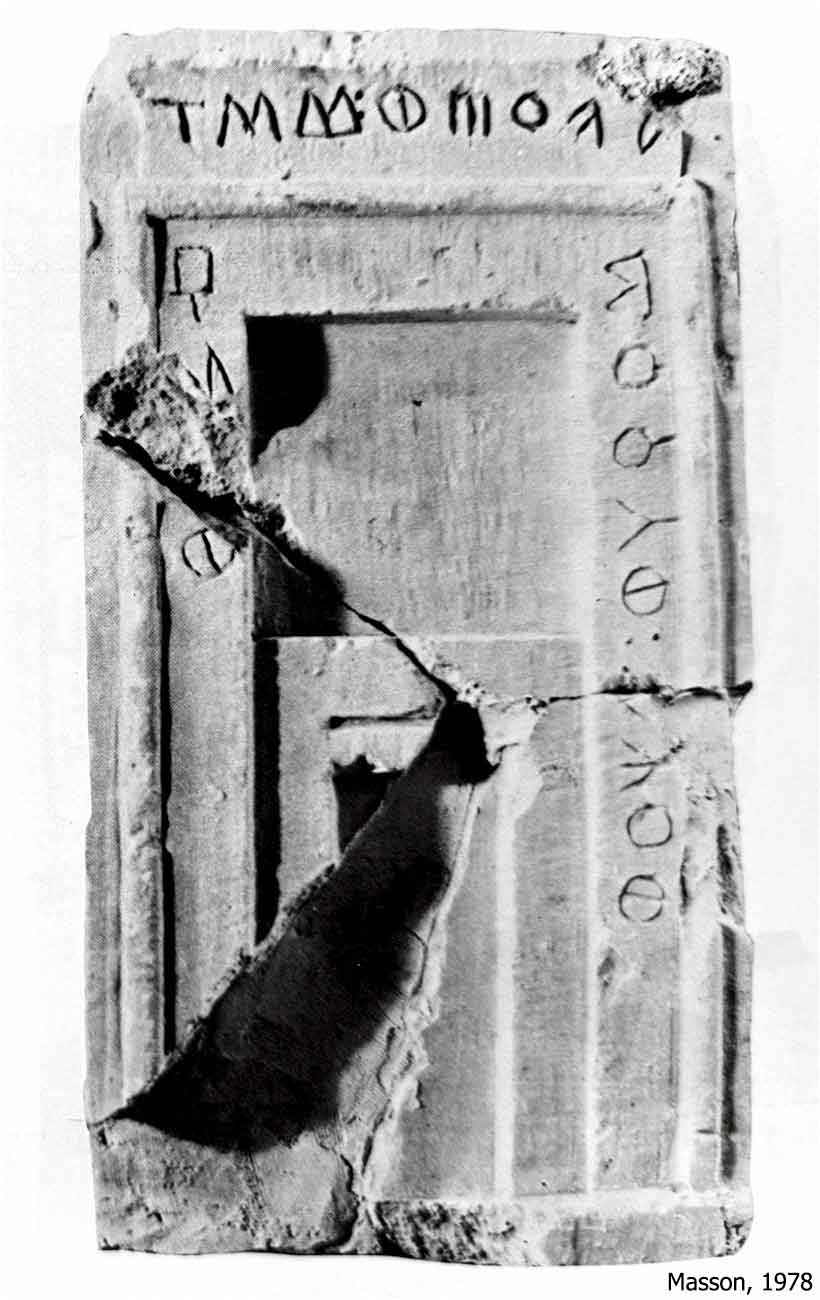

(←)
1 irowś psTým[.]ś pttuś mnoś
E.Me 28
The almost intact limestone stele of false-door type (38.5 x 20.3 x 6.8 cm) was found in the 1968-69 season. The two-line inscription runs right-to-left, which might be read: “This (is the stele) of Sanuq (son?) of Pntmun, the mercenary(?).” The stele is in the inventory of the Cairo Museum (JdE 91372).

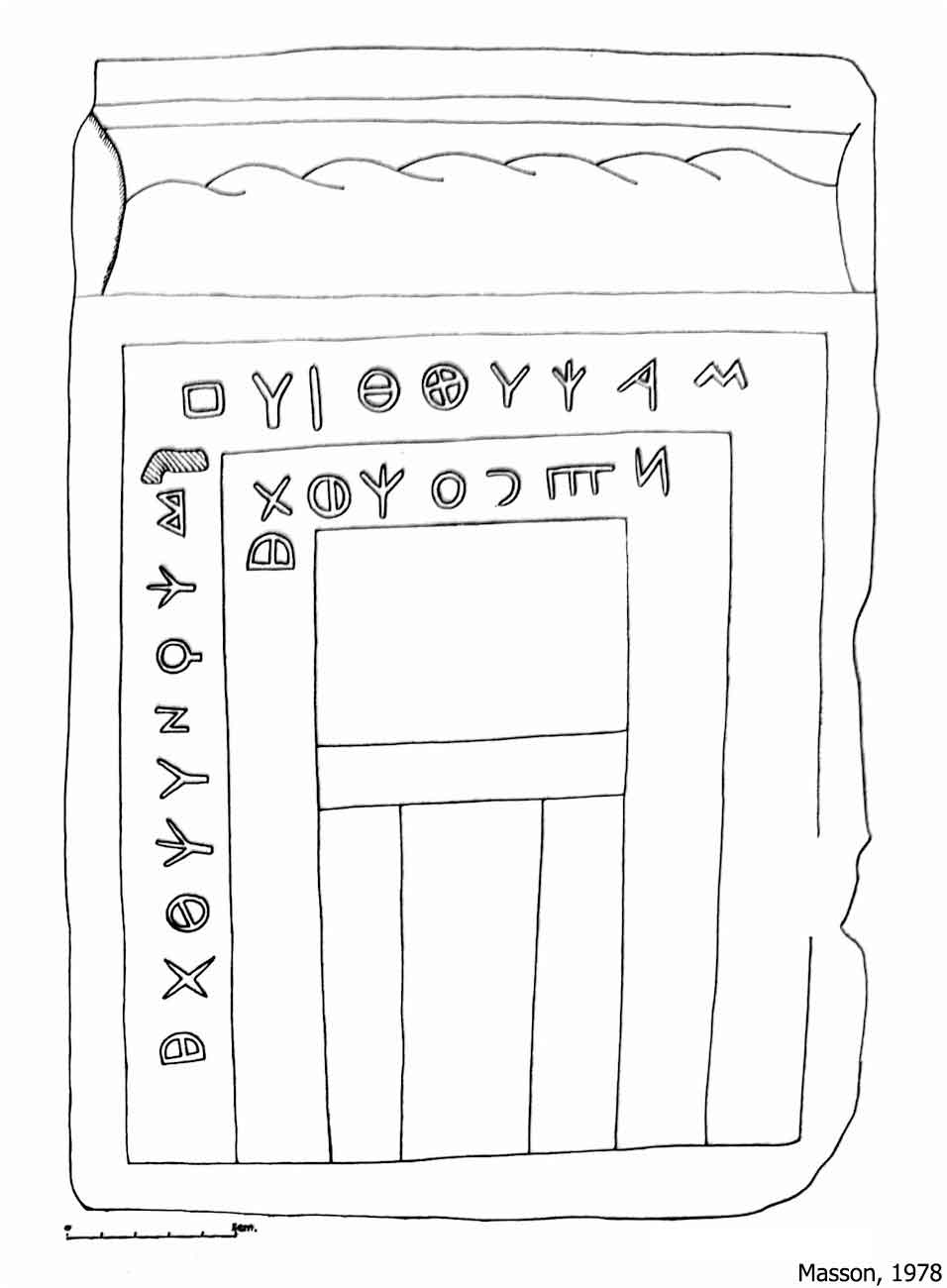
(←)
1 sanuqś ue pntmunś k̑i
2 mwdonś k̑i
E.Me 29
The limestone stele of false-door type (33.8 x 20 x 7.5 cm) was found in the 1968-69 season. The right-to-left running inscription on the outer frame is damaged on the right side. It has a typical onomastic formula. Either the deceased or his/her father is identified as a mercenary(?) (mwdon). The stele is in the inventory of the Cairo Museum (JdE 91382).


(←)
1 s[..]etś [ue?] ynemoriś mwdonś
E.Me 30
The false-door type limestone stele (40 x 24.6 x 8 cm) was found in the 1968-69 season. Despite damage to the left side, the right-to-left running two-line inscription is intact. It has been speculated that the last word, śuγλi, which is also mentioned on a couple of other steles, might be an ethnic attribute that refers to the the location name Souangela. The stele is in the inventory of the Cairo Museum (JdE 91381).

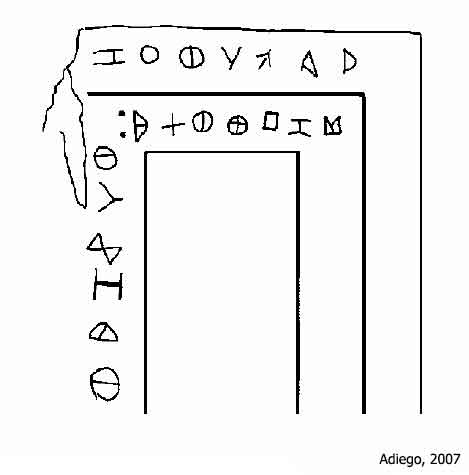
(←)
1 šaruśoλ
2 pλeqś k̑i śuγλiś
E.Me 31
The false-door type limestone stele (35 x 21.7 x 7.2 cm) was found in the 1968-69 season. The right-to-left running inscription on the outer frame is almost intact. The initial word was suggested to be a profession meaning ‘hour-observer, horoscoper, astronomer’ (Vittmann 2001). The stele is in the inventory of the Cairo Museum (JdE 91380).


(←)
1 wnutiś kwarś mTmś k̑i mwdonś [k̑]i
E.Me 32
The false-door type limestone stele (35.5 x 20 x 7 cm) was found in the 1968-69 season. The right-to-left running inscription on the outer frame is almost intact. The deceased, Iturow, is apparently a woman, since she is identified as the mother of a mercenary(?) named Kbjom. The stele is in the Birmingham Museum and Art Gallery.

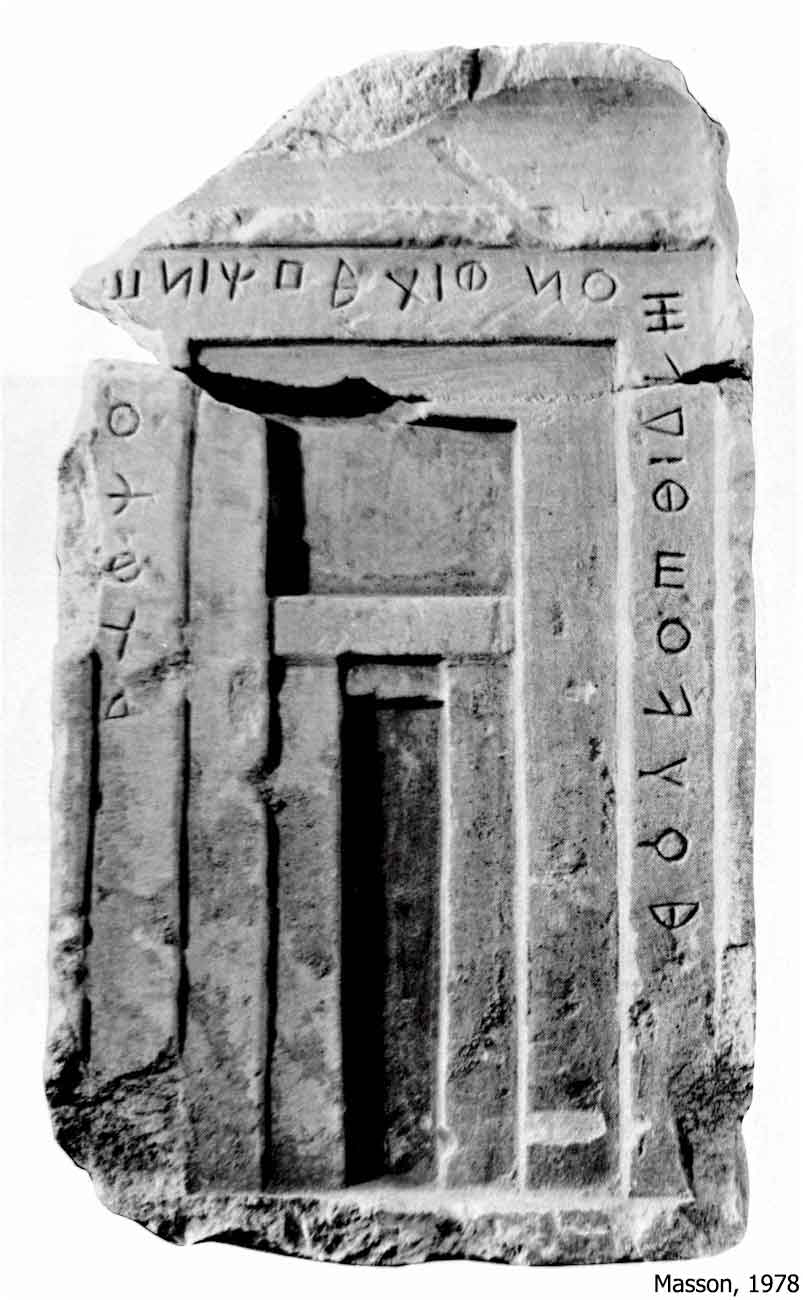

(←)
1 iturowś kbjomś k̑i en mw[d]onś k̑i
E.Me 33
The false-door type limestone stele (28.5 x 18.7 x 6.5 cm) was found in the 1968-69 season. The Carian inscription is written in two parts. The lower inscription (b), written in two lines above the ‘door,’ repeats the first half of the top inscription (a), “Idmn(s) (son) of Myre.” The upper inscription adds an ethnic(?) identifier. The stele is in the inventory of the Cairo Museum (JdE 91379).
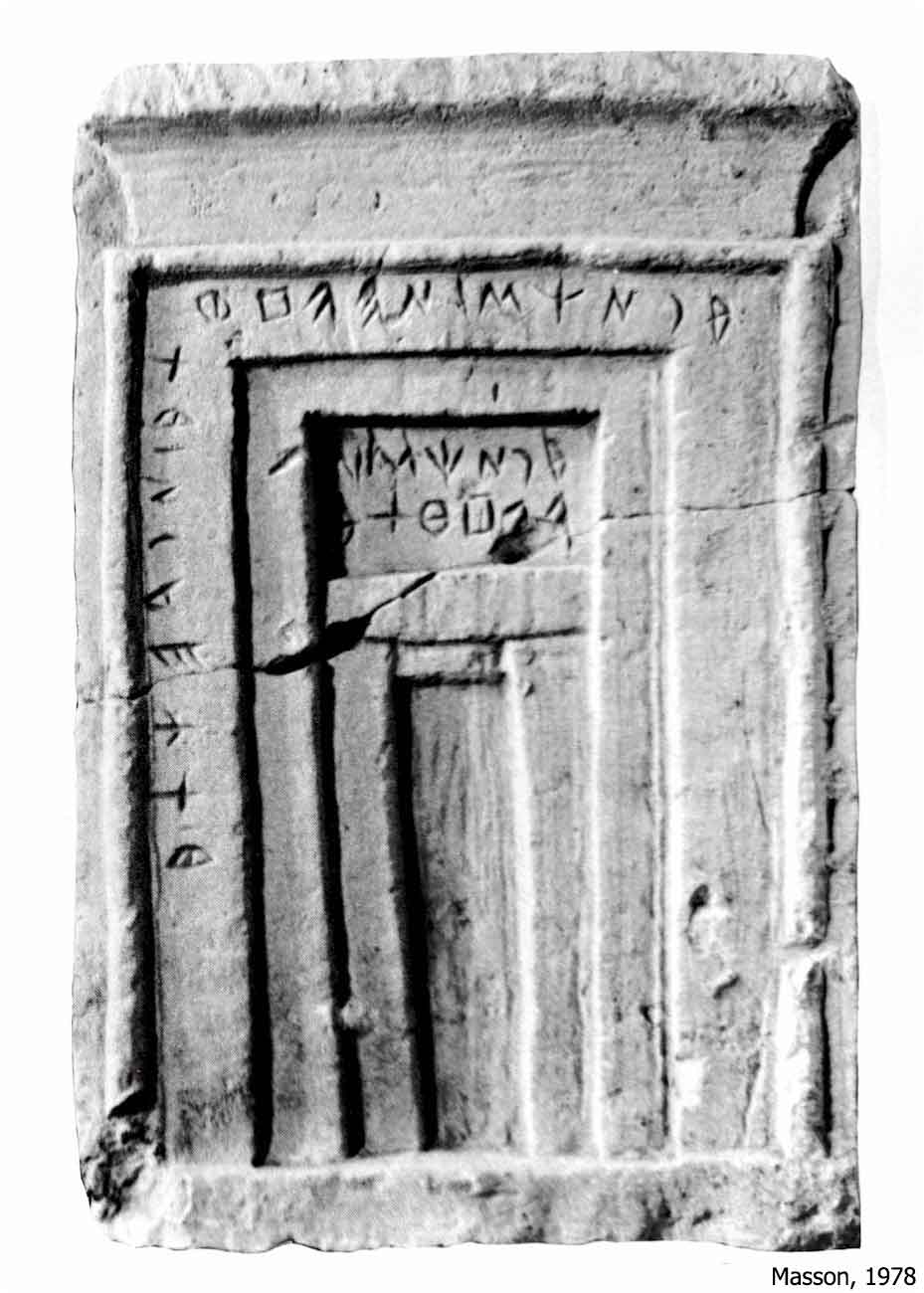

(←)
a idmns myreś k̑i mdayn k̑i
b idmns myreś k̑i
E.Me 34
The limestone stele of false-door type (37 x 26.9 x 7.6 cm) was found in the 1968-69 season. The right-to-left running inscription on the inner frame is an onomastic formula with personal names. The stele is in the inventory of the Cairo Museum (JdE 91378).


(←)
1 meĺś somneś tĺk̑ata[r]ś
E.Me 35
The limestone stele of false-door type with a simplified design (33 x 22 x 6.5 cm) was found in the 1968-69 season. The single line inscription runs right-to-left. The first name, Ntokris, corresponds to a well known Egyptian female name, Nitokris. If so, the text might be read: “Ntokris (daughter) of Dwśoλ, the mercenary(?).” The stele is in the inventory of the Cairo Museum (JdE 91377).
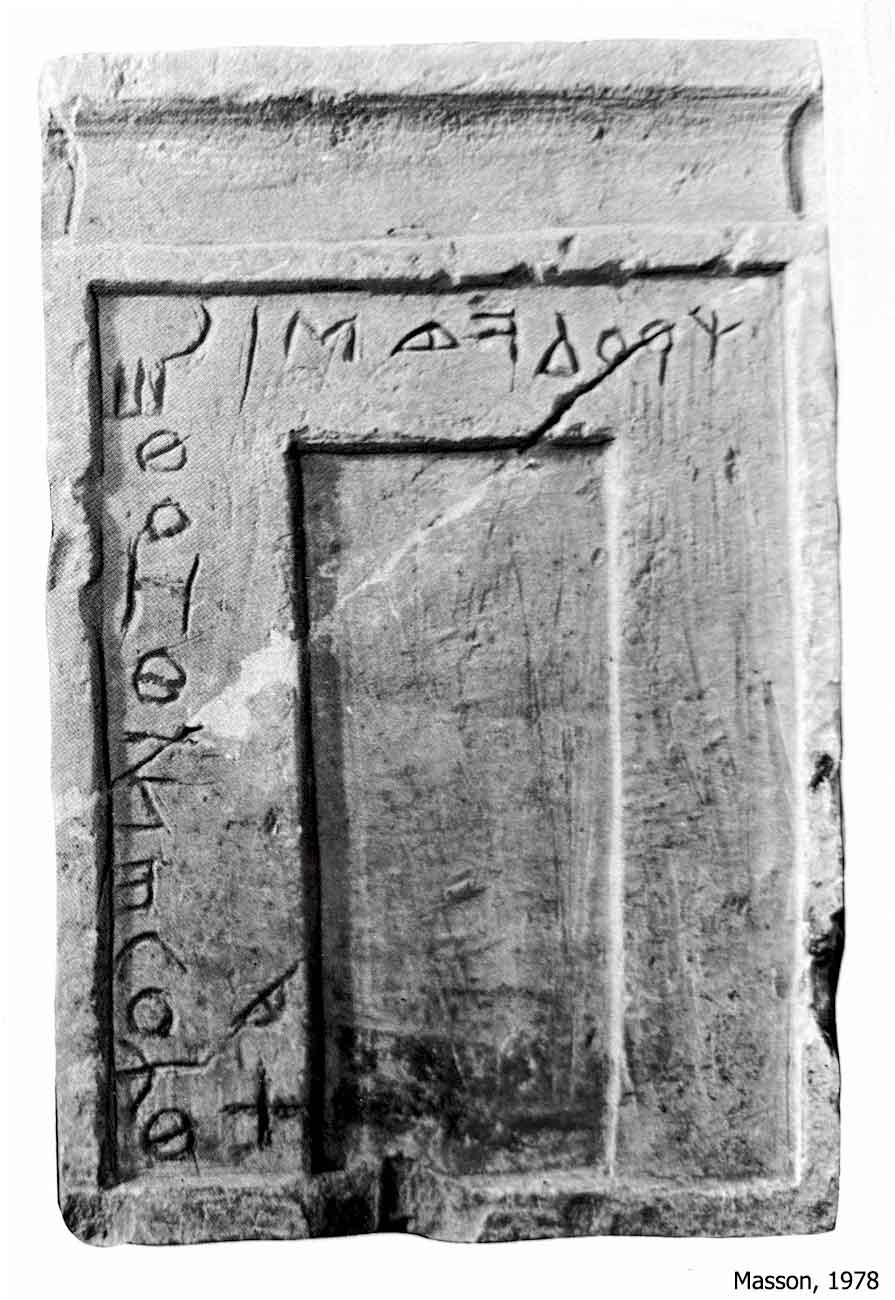

(←)
1 ntokris dwśoλś mwdonś
2 k̑i
E.Me 36
The limestone stele of false-door type (35 x 20.2 x 7.5 cm) was found in the 1968-69 season. The inscription appear to have been written in two different orientation. The way it is analyzed, top line and left side is read right-to-left (sinistroverse) and the right side (qarpsiś) is written from top to bottom, left-to-right (dextroverse). It is an onomastic formula with multiple names. The stele is in the inventory of the Cairo Museum (JdE 91376).


(⇆)
1 wksmuś wpe lkorś k̑j qarpsiś
E.Me 37
The limestone stele of false-door type (30 x 17.9 x 5 cm) was found in the 1968-69 season. The incription is written in two-lines. An indeterminate portion of the ending of the top line that might have continued on the damaged left section of the outer frame has been lost. The stele is in the inventory of the Cairo Museum (JdE 91375).


(←)
1 qlaλiś […] tkraβiś
E.Me 38
The badly damaged limestone stele of false-door type (33.8 x 24.5 x 7 cm) was found in the 1968-69 season. The inscription runs right-to-left at the top, and continues on the left frame from top to bottom in the left-to-right orientation. It might be read: “The stele of Šýin, who (is) the father of Arie.” The stele is in the Ashmolean Museum (AN1971.107).

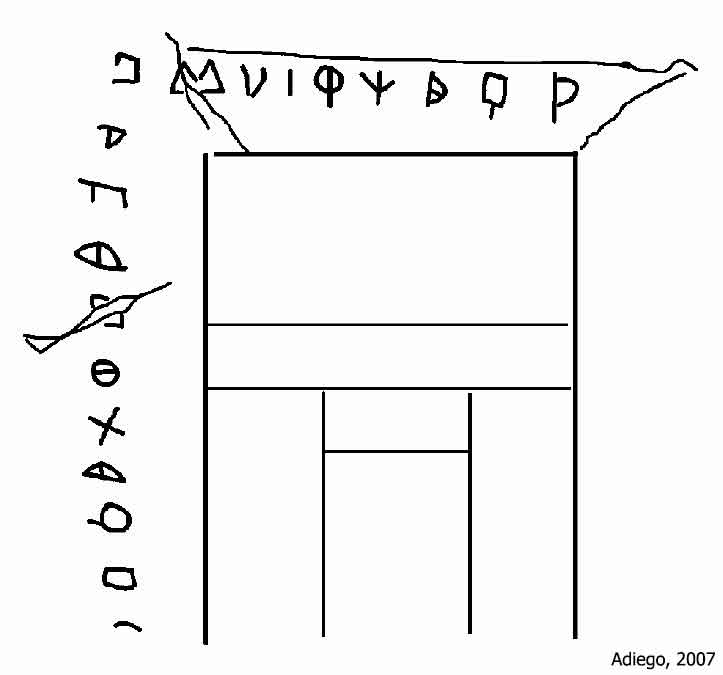
(⇆)
1 šýinś upe arie?ś k̑i ted
E.Me 39
The badly damaged limestone stele of false-door type (26 x 20.6 x 6 cm) was found in the 1968-69 season. The inscription runs right-to-left at the top and left side frame. However, for the reading order scholars prefer to read the left side first ([…]s? ark̑ilaś) and then the top (mnoś), since the latter is identified as ‘son’ and comes after the names in multiple other inscriptions. The stele is in the British Museum (EA67242).


(←)
1 […]s? ark̑ilaś mnoś
E.Me 40
The limestone stele of false-door type with a simplified design (30.5 x 20.8 x 7 cm) was found in the 1968-69 season. The inscription runs left-to-right at the top and right side frame. Characters on the right side are written upright in a column. The named deceased is identified as a mercenary(?). The stele is in the Oriental Museum of Durham University, England (DUROM.1971.140).
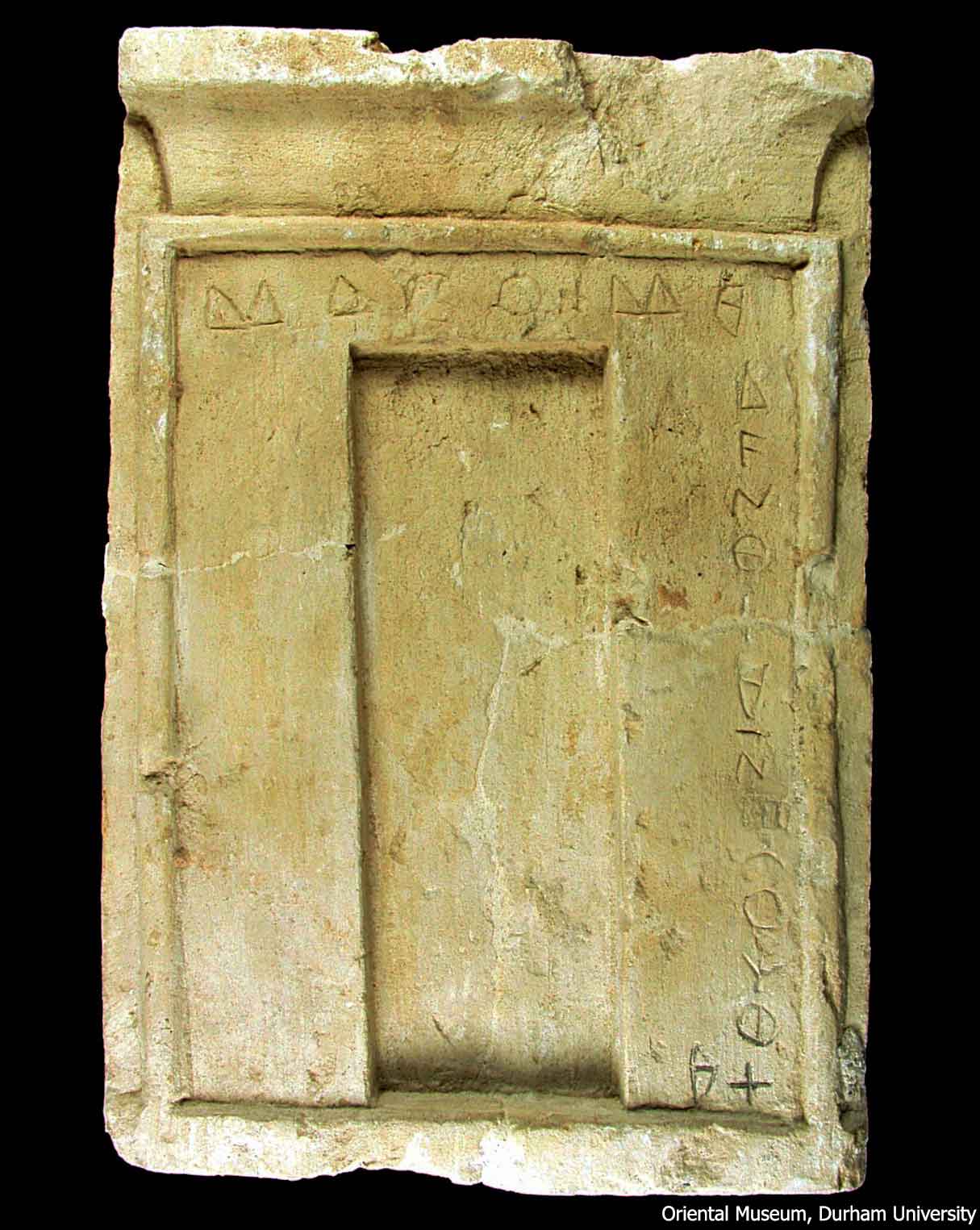


(→)
1 plqo pikrmś k̑i mwdonś k̑i
E.Me 41
The limestone stele of false-door type (32.5 x 21.5 x 6.7 cm) was found in the 1968-69 season. The inscription runs left-to-right on the left, top, and right side of the inner frame. It is an onomastic formula with multiple names. The stele is in the inventory of the Cairo Museum (JdE 91374).
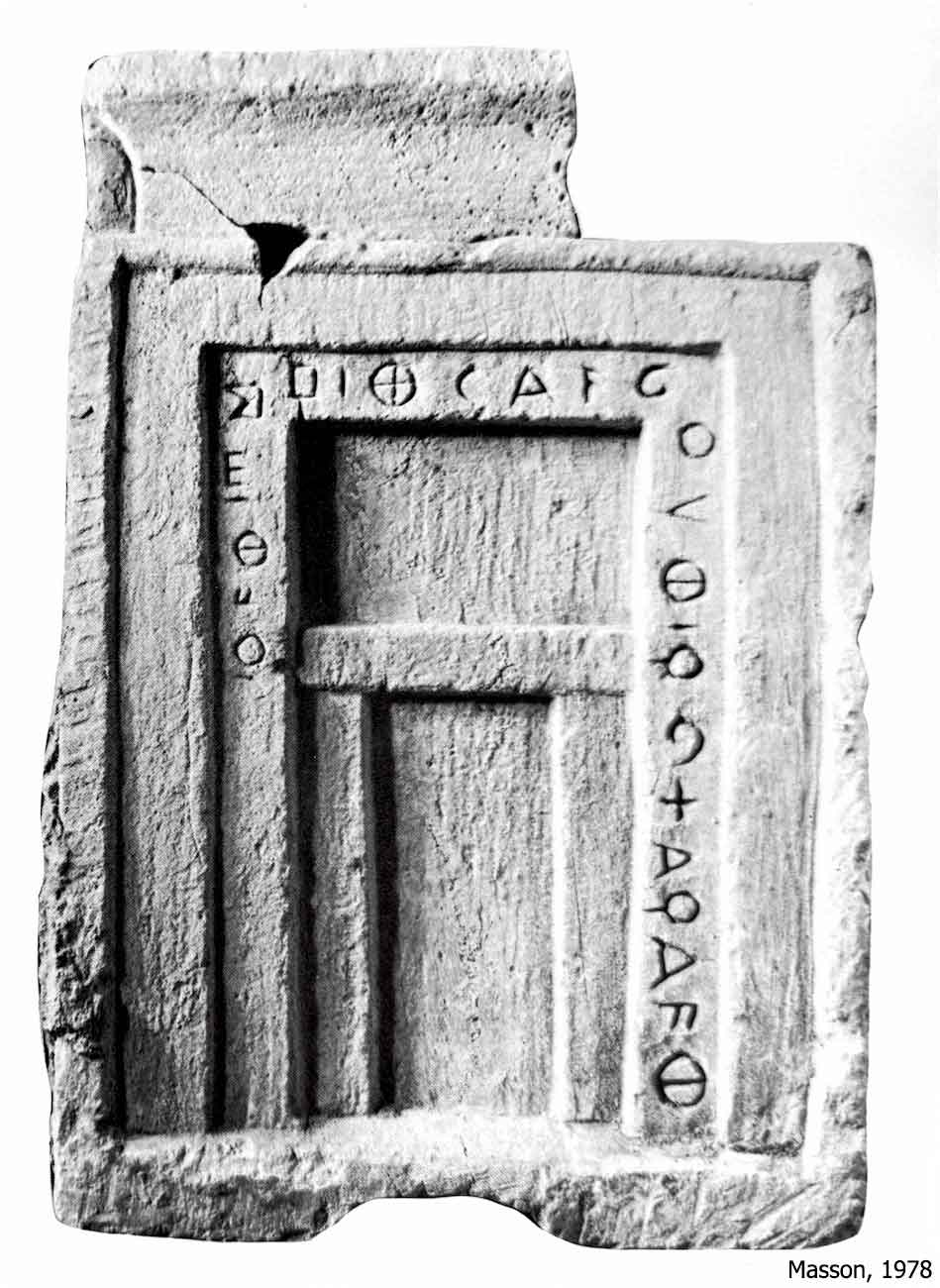
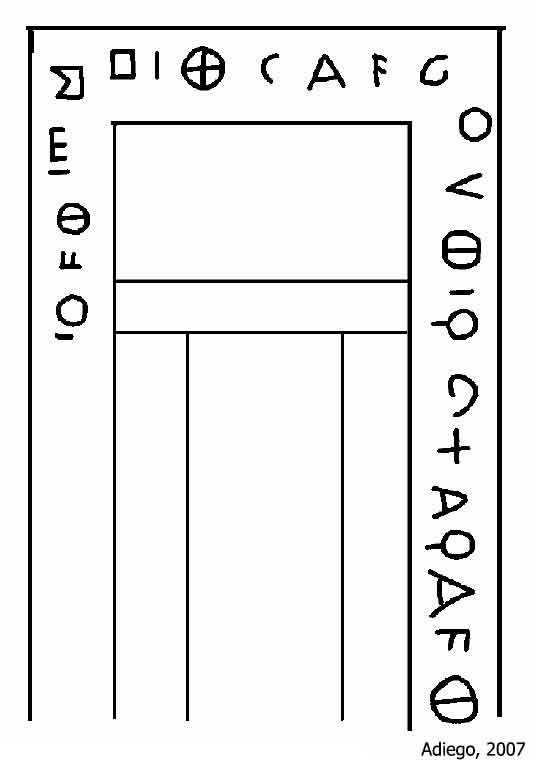
(→)
1 orś wpe qdarĺouś tĺk̑atarś
E.Me 42
The well-preserved limestone stele of false-door type (33.5 x 23.5 x 6.5 cm) was found in the 1969-70 season. The two-line inscription is written on outer and inner frames. Both lines start on the right side and run sinistroverse. It is an onomastic formula with multiple names. It might be read: “This (is the stele) of Arjom, who (is the son) of Mwsat, the mercenary(?), the (son) of Tbridbδś.” The stele is in the inventory of the Cairo Museum (JdE 91374).


(←)
1 arjomś ue mwsatś k̑i mwdonś
2 tbridbδś k̑i
E.Me 43
The well-preserved limestone stele of false-door type (37.5 x 19.3 x 6 cm) was found in the 1969-70 season. The inscription starts at the top right corner, sinistroverse, through the top of the frame and then downward on the left side of the frame. The line on the right side of the frame, which is also sinistroverse and starts at the bottom, might have been added later. It is an onomastic formula with multiple names. In fact stele might belong to two individuals: “The stele of Lýk̑si (son?) of Šrquq, of (the city?) of Kasolba?, (and) of Arliom who (is his) son.” The stele is in the inventory of the Cairo Museum (JdE 91515).


(←)
1 lýk̑siś upe šrquqś k̑i ksolbś arliomś mnoś k̑i
E.Me 44
The limestone stele of false-door type (26.3 x 19.1 x 8 cm) was found in the 1969-70 season. The inscription is written on all three sides of the inner frame (a) and on the cornice (b), both sinistroverse (right-to-left). The first two words are personal names: “Apmen (son?) of Šrquq.” It has been speculated that the kojoλ might mean ‘shepherd’ (Schürr 1992: 155), which would be the profession of Apmen. The word mwton (mercenary?), which was added on the cornice, would be the profession of the father, Šrquq. Since Apmen is a typical Egyptian name, this suggests Šrquq chose an Egyptian name for his son. The stele is in the inventory of the Cairo Museum (JdE 91517).


(←)
a apmen šrquqś kojoλ k̑i
b1 mwtonś
b2 k̑i
E.Me 45
The limestone stele of false-door type (28 x 19.5 x 6.7 cm) was found in the 1969-70 season. The inscription is written horizontally in three dextroverse lines on the cornice and the top section of the outer frame. One or two signs have been lost due to damage at the top left corner. The phrase alos k̑arnos that follows the two personal names is suggested to be the Carian name of Halikarnassos (Adiego 2019). The stele is in the Petrie Museum of University College London (LDUCE-UC2406).


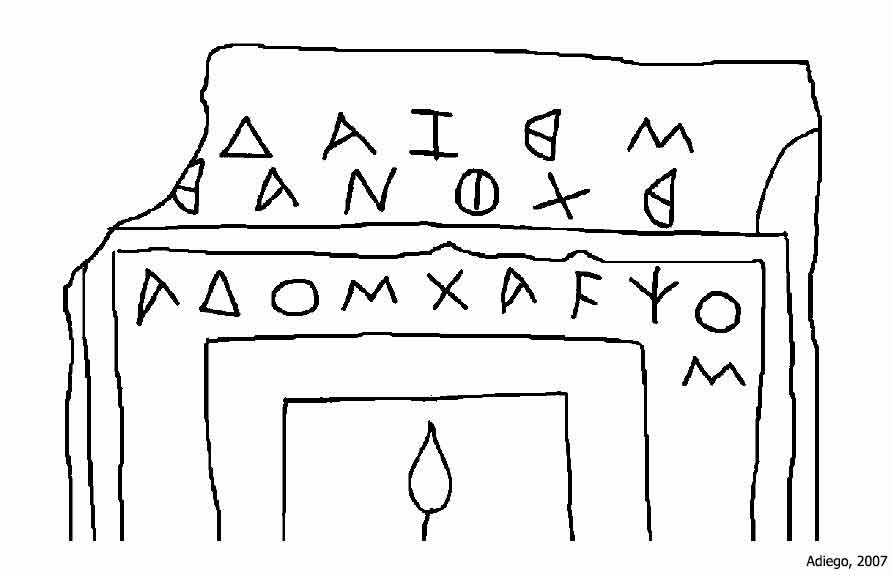
(→)
1 [q?]laλiś [.?]iamś k̑i alos k̑arnos
E.Me 46
The limestone stele of false-door type (38 x 24 x 7 cm) was found in the 1969-70 season. The inscription is engraved superficially and carelessly on the cornice (b) and top section of the outer frame (a), both lines are right-to-left. “(The stele of) Ýasδ (son?) of Yiśbiks, the mercenary(?).” The stele is in the Petrie Museum of University College London (LDUCE-UC2403).


(←)
a ýasδś yiś{k̑}biksś k̑i
b mwdonś k̑i
E.Me 47
The limestone slab (26 x 48 x 5.5 cm), face of which is covered with black painted floral motifs, was found in the 1968-69 season. The purpose of the slab is unclear. The single-line inscription is written right-to-left on one of the four lateral faces. The inscription might be read: “Tqte(s) the so[n] of Paraiβreλ.” The slab is in the British Museum (EA67255).

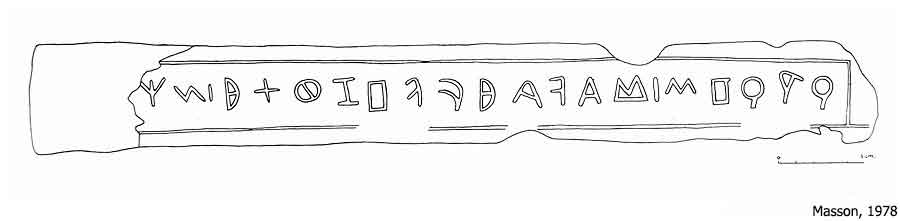
(←)
1 tqtes paraiβreλś k̑i mn[o.?]
E.Me 48
Possibly the upper part of a roughly worked rectangular stele of limestone (20 x 16.8 x 7.8 cm) was found in 1968. The sinistroverse inscription is written in four lines and features an onomastic formula. The fragment is in the Petrie Museum of University College London (LDUCE-UC2404).

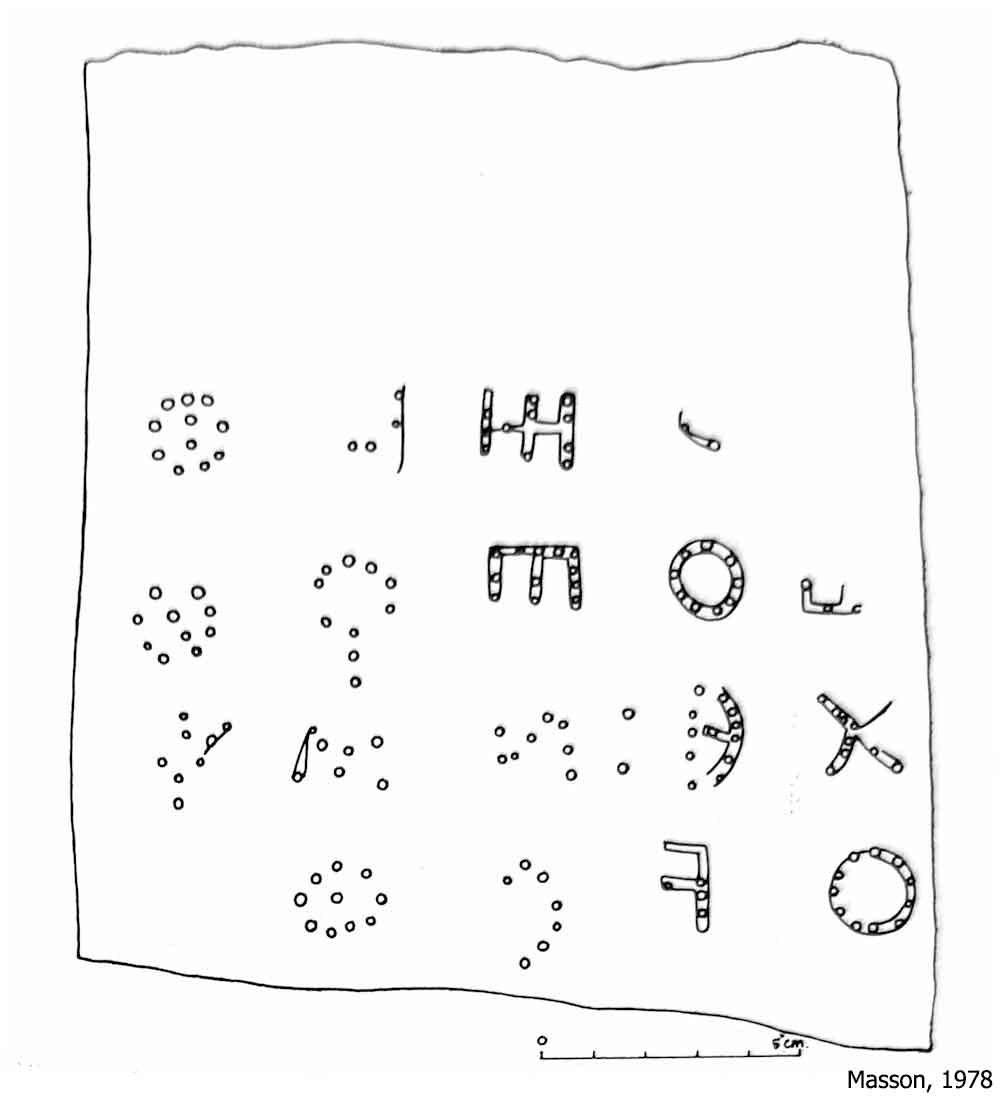
(←)
1 [..]jś
2 [.]owtś
3 k̑i
3-4 msnordś
E.Me 49
The roughly rectangular limestone block (27 x 42 x 27 cm) was found in 1969(?). It bears an irregularly engraved two-line inscription runs boustraphedon, first line dextroverse and the second sinistroverse. It is unlike any inscription from Saqqâra and uncertain whether all words are personal names. The block was kept in storage in Saqqâra.

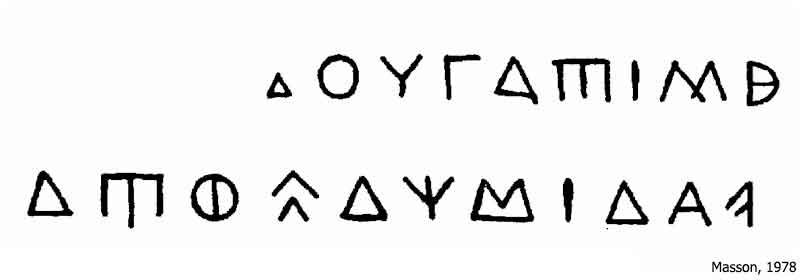
(⇄)
1 loubaw
1-2 siral
2 pnlδśwl
E.Me 50
The oblong limestone stele was found in the 1968-69 season as reused in a wall of an underground passage in the lower Babboon Gallery in Saqqâra, presumably still in situ. The two line inscription is sinistroverse and can be read: “Šenurt (son?) of Pk̑simt.” The dimensions of the stele is unknown. The inscription length is less than 15 cm.
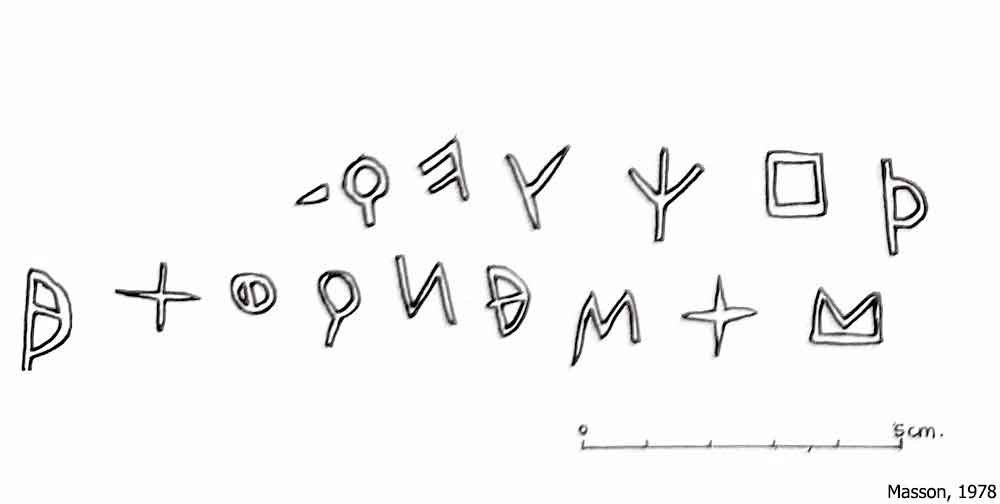
(←)
1 šenurt
2 pk̑simtś k̑i
E.Me 51
The upper section of a round-topped limestone stela (12.70 x 27.4 cm) was found in the 1969-70 season. Other than the lightly engraved inscription, it is devoid of any decoration. The sinistroverse inscription on the upper edge is an onomastic formula: “This (stele is) of Arliš (son?) of Psikro [..?].” The stele fragment is in the British Museum (EA67241).
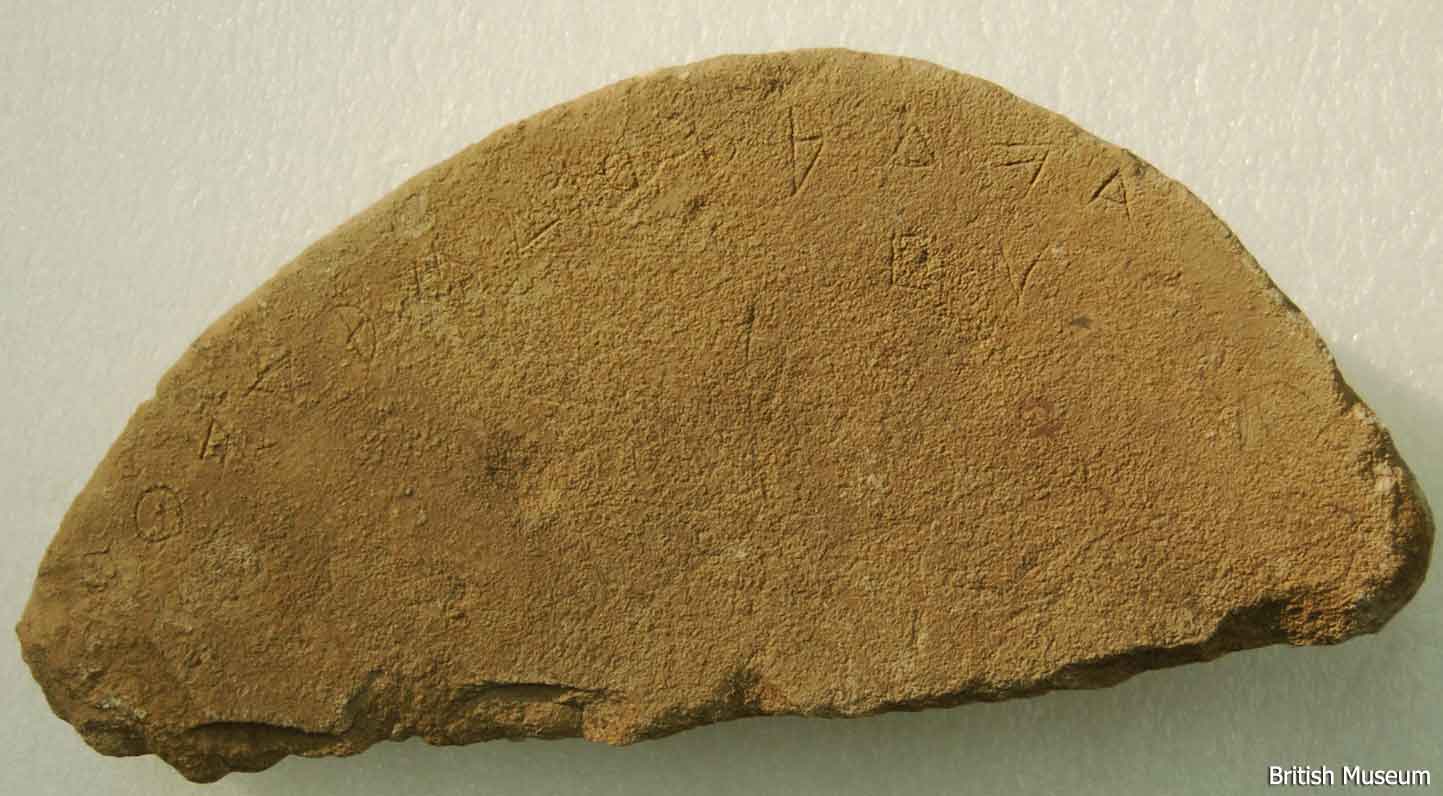


(←)
1 arlišś psikroś […?] ue
E.Me 52
The limestone fragment from the upper part of a false-door type stele (10.4 x 18 cm) was found in the 1968-69 season. The fragmentary inscription is sinistroverse and part of an onomastic formula. The fragment is in the British Museum (EA67248).
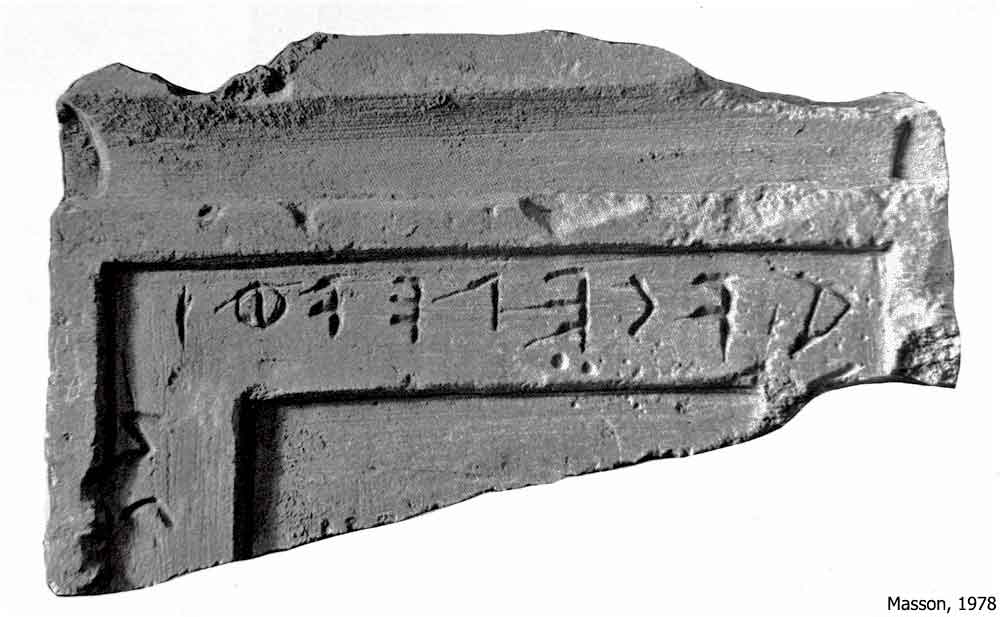

(←)
1 […?] ardybyrś md[…]
E.Me 53
The limestone fragment from the cornice section of a false-door type stele (9.4 x 14.4 cm) was found in the 1968-69 season. Only a few characters of the inscription survives. The fragment is in the Fitzwilliam Museum in Cambridge, England (E.10.1969).
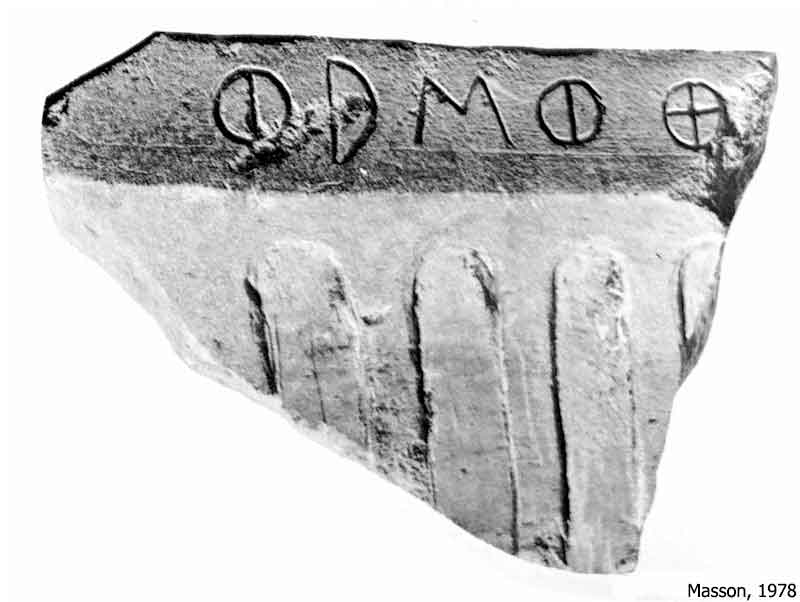

(←)
1 […]qśsiś
E.Me 54
The limestone fragment from the bottom right corner of a false-door type stele (14 x 10.5 cm) was found in the 1968-69 season. Sinistroverse text is on the right side of the outer frame. The fragment is in the British Museum (EA67246).


(←)
1 […?] mrsj[…]
E.Me 55
The limestone fragment of indeterminate nature (4.4 x 15 cm) was found in the 1968-69 season. The few surviving letters might be the beginning of the personal name Psmaśk , Carian adaptation of the Egyptian name Psmtk. The fragment is in the British Museum (EA67245).


(←)
1 psma[ś/šk …]
E.Me 56
The limestone fragment from the bottom right corner of a false-door type stele (14 x 16.5 cm) was found in the 1968-69 season. The sinistroverse inscription on the right bottom side of the outer frame is likely the beginning of the inscription, perhaps that of the personal name Šarkbiom known from elsewhere. The fragment is in the British Museum (EA67247).

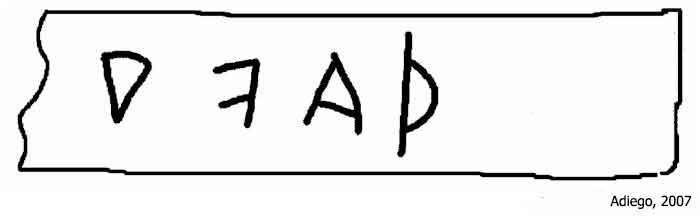
(←)
1 šark[bi/jom …]
E.Me 57
The limestone fragment from the bottom left corner of outer frame of a false-door type stele (15.9 x 9.5 cm) was found in the 1968-69 season. It is apparently the end of a onomastic formula. The fragment is in the British Museum (EA67250).


(←)
1 […]iś k̑i
E.Me 58
The limestone fragment of indeterminate nature (10.5 x 12.5 cm) was found in the 1968-69 season. The few surviving letters are likely the end (or part) of an onomastic formula. The fragment is in the British Museum (EA67240).


(←)
1 […]sś k̑i
E.Me 59
The small limestone fragment, possibly from the upper left corner, of a false-door type stele (5.6 x 4.2 cm) was found in1970-71(?) season. Only a few characters survive. The fragment is in the British Museum (EA67244).
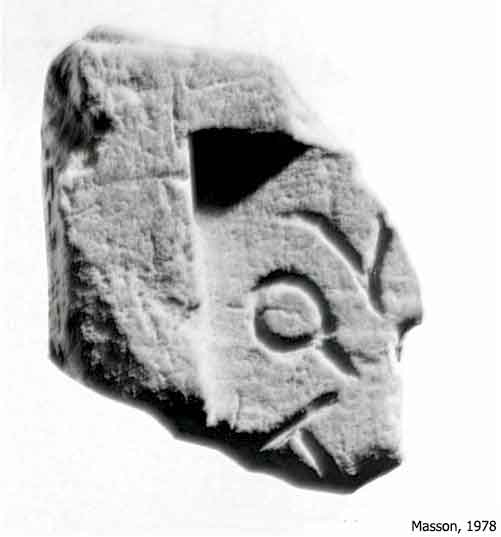

(←)
1 […]utr[…]
E.Me 60
The small limestone fragment from the edge of a false-door type stele (width 6.5 cm) was found in the 1968-69 season. The fragment was kept in storage in Saqqâra.


(→?)
1 […]k̑ś
E.Me 61
The small limestone fragment (2.7 x 6.5 cm) was found in 1972. The fragment was kept in storage in Saqqâra.
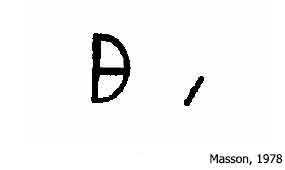
(←?)
1 […]xi
E.Me 62
The small limestone fragment (4.5 x 4 cm) was found in 1972. The fragment was kept in storage in Saqqâra.

(?)
1 […]ś[…]
E.Me 63
The limestone fragment from the top section of a false-door type stele (16.2 x 18.6 cm) was found in1974. The first linen of the inscription is likely a personal name. Below the engraved vertical line only one letter is visible. The fragment was kept in storage in Saqqâra.
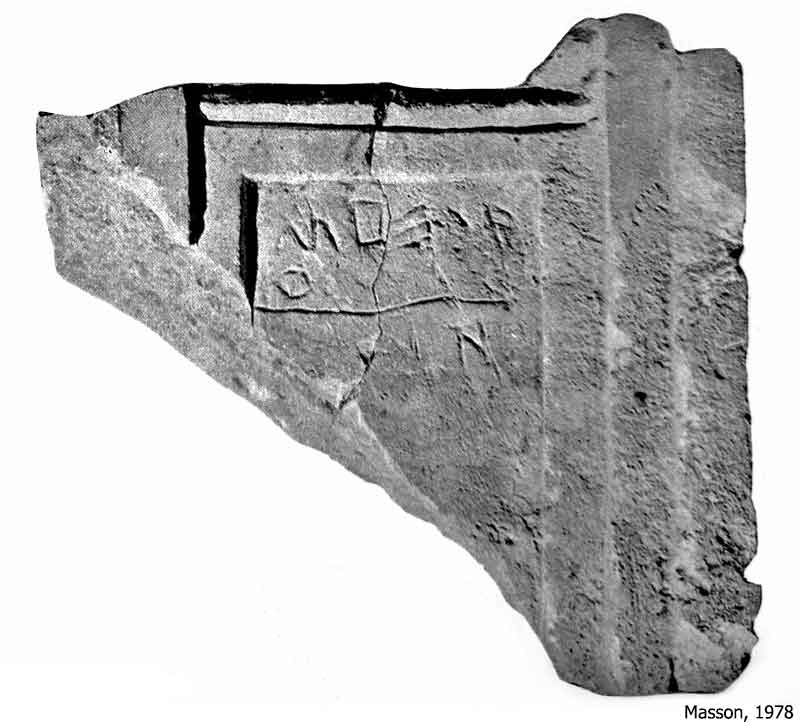

(←)
a idyesś
b m […?]
E.Me 64
The limestone fragment from the upper left section of a roun-topped stele (10 x 11 x 5 cm) was found in 1975 in secondary context. It has the remains of a two-line inscription. The fragment was kept in storage in Saqqâra.

(←)
a […w/u?]pe pd[…]
b […]mi
E.Me 65
The rectangular limestone stele (37 x 32 x 9 cm) was found in 1980 during excavations by L. Borchardt in northern Saqqâra. The front face shows a funerary ritual. The lightly inscribed and hard to read incription is on the right side of the scene parallel to the edge running sinistroverse from bottom up. It appears to be an onomastic formula that possibly ends with the word for mercenary(?). The stele is in the Ägyptisches Museum in Berlin (ÄM 19553).


(←)
1 u[…]m punm[.]ś mudo[n]ś
E.Me 66
Two joining fragments from the left side of a round-topped? stele (20.5 x 16.2 cm) were probably found in the 1968-69 season. The front face shows a funerary ritual. On the right side, parallel to the edge are the remains of a Carian inscription. The reading direction is unclear. The fragment is in the British Museum (EA67238+67239).

Kammerzell (1993):
1 […]x[..]u[…]p[.]n[…]
E.Me 67(?)*
The Carian graffito graffito on a white limestone block was found in 2019 by the mission of the Czech Institute of Egyptology within the area known as Ty’s cemetery located in the transitional zone between the modern archaeological sites of Abusir and Saqqâra. It was found within a Late Period structure that served a cultic purpose. The two-line inscription is written boustraphedon. Content of the inscription is largely elusive although dbiks is known as a personal name from elsewhere (E.Th 13). It is suspected to be a visitor’s graffito. The the structure and the inscription has been dated to the 5th century BCE.
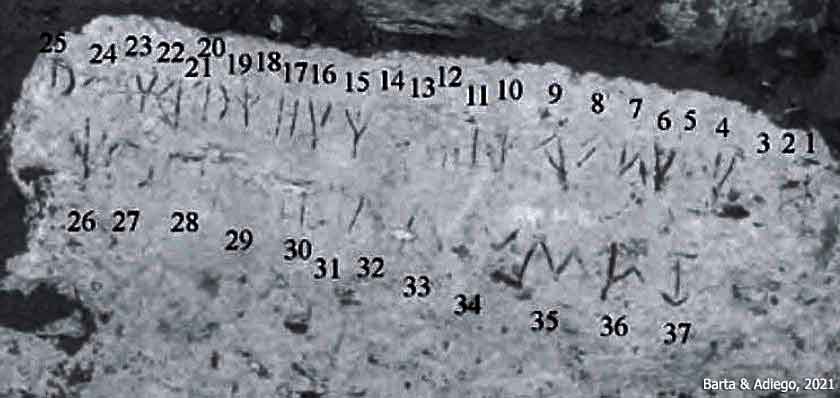
(⇆)
1 […?] x-a/l-n k/u-mδane konu-j/e2-n dbiksś
2 nowsś x-x-msaλ
* eDiAna labels this inscription as E.Ab 44, presumably due to a Abusir/Abydos mixup.
References:
Adiego, I.- J. 2007. The Carian Language, Leiden/Boston (E.Me 1–E.Me 66).
Adiego, I.- X. 2019. “A Kingdom for a Carian Letter,” in Luwic Dialects and Anatolian. Inheritance and Diffusion, eds. I.-X. Adiego et al., Barcelona, 11–50.
Bárta, M. & Adiego, I.-X. 2021. “A new Carian inscription from the cemetery of Ty,” in Abusir and Saqqara in the Year 2020, eds. M. Bárta, F. Coppens, J. Krejčí, Prague, 303–308. (E.Me 67)
Kammerzell, F. 1993. Studien zu Sprache und Geschichte der Karer in Ägypten, Wiesbaden. (144 n.101, E.Me 66)
Masson, O. & Yoyotte, J. 1956. Objets pharaoniques à inscription carienne, Cairo. (Docs. A–B, D–H, K = E.Me 1–E.Me 8)
Masson, O. 1978. Carian Inscriptions from North Saqqâra and Buhen, London. (Nos.1–49, Appdx.I = E.Me 9–E.Me 65)
Ray, J. 2006. “Inscriptions and Ostraca in the Nicholson Museum: Hieroglyphic, Hieratic, Demotic and Carian,” in Egyptian Art in the Nicholson Museum, Sydney, eds. K. N. Sowada & B. G. Ockinga, Sydney, 211–224 (211–214, E.Me 6)
Schürr, D. 1992. “Zur Bestimmung der Lautwerte des karischen Alphabets,” Kadmos 31, 127–156.
Schürr, D. 2003. “Zur karischen Inschrift der Stele von Abusir”, Kadmos 42, 91–103. (E.Me 65)
Simon, Z. 2021. “Who is a mdayn / mdaýn? On the Carians in Egypt,” Egitto e Vicino Oriente 44, 175–189.
Vittmann, G. 2001. “Ägyptisch-Karisches,” Kadmos 40, 39–59.
Images:
O. Masson & J. Yoyotte, 1956
O. Masson, 1978
D. Schürr, 2003
I.-J. Adiego, 2007
Louvre Museum, 2010
Musées royaux d’Art et d’Histoire, Brussels (CC BY-NC-SA 4.0)
Chau Chak Wing Museum, the University of Sydney
Fitzwilliam Museum, Cambridge (CC BY-NC-ND 4.0)
British Museum (CC BY-NC-SA 4.0)
Petrie Museum, UCL (CC BY-NC-SA 4.0)
Birmingham Museum and Art Gallery (CC BY-NC-SA 4.0)
Oriental Museum, Durham University