Euromos was a significant city in ancient Caria, located about 12 km northwest of Mylasa (modern Milas). It sits on flat ground surrounded by hills, positioned along a north-south ancient road axis that parallels the modern Milas-Söke highway. The city overlooks the Yaşyer Plain that may have been connected to the sea in earlier periods, potentially making early Euromos a coastal settlement.
Settlement traces date back to the 8th century BCE but the earliest mention of Euromos was a tribute-paying member of the Delian League in 454/453 BCE. The city appeared in Athenian tax lists as Kyromos / Hyromos. Euromos name is adopted during the Hellenization policies of Mausolus in the 4th century BCE. For a brief period in the early 2nd century BCE, the city was renamed Philippoi while under the control of the Macedonian King Philip V. Following the Peace of Apameia (188 BCE), the city came under Rhodian influence but struggled against the dominance of neighboring Mylasa. Eventually the city regained independence and minted its own coinage featuring Zeus Lepsynos, the double-axe (labrys), and the eagle. Euromos flourished under Rome, maintaining its status as an independent city-state. The Roman period sources referred to Euromensium Oppida (towns of Euromos), suggesting a sympoliteia or federation of settlements comprising Euromos, Olymos, Chalcetor, and Pidasa. Major construction, including the current temple and bath complex, occurred during the Roman era. In the Byzantine period, the city remained inhabited but was administratively attached to the Bishopric of Mylasa.
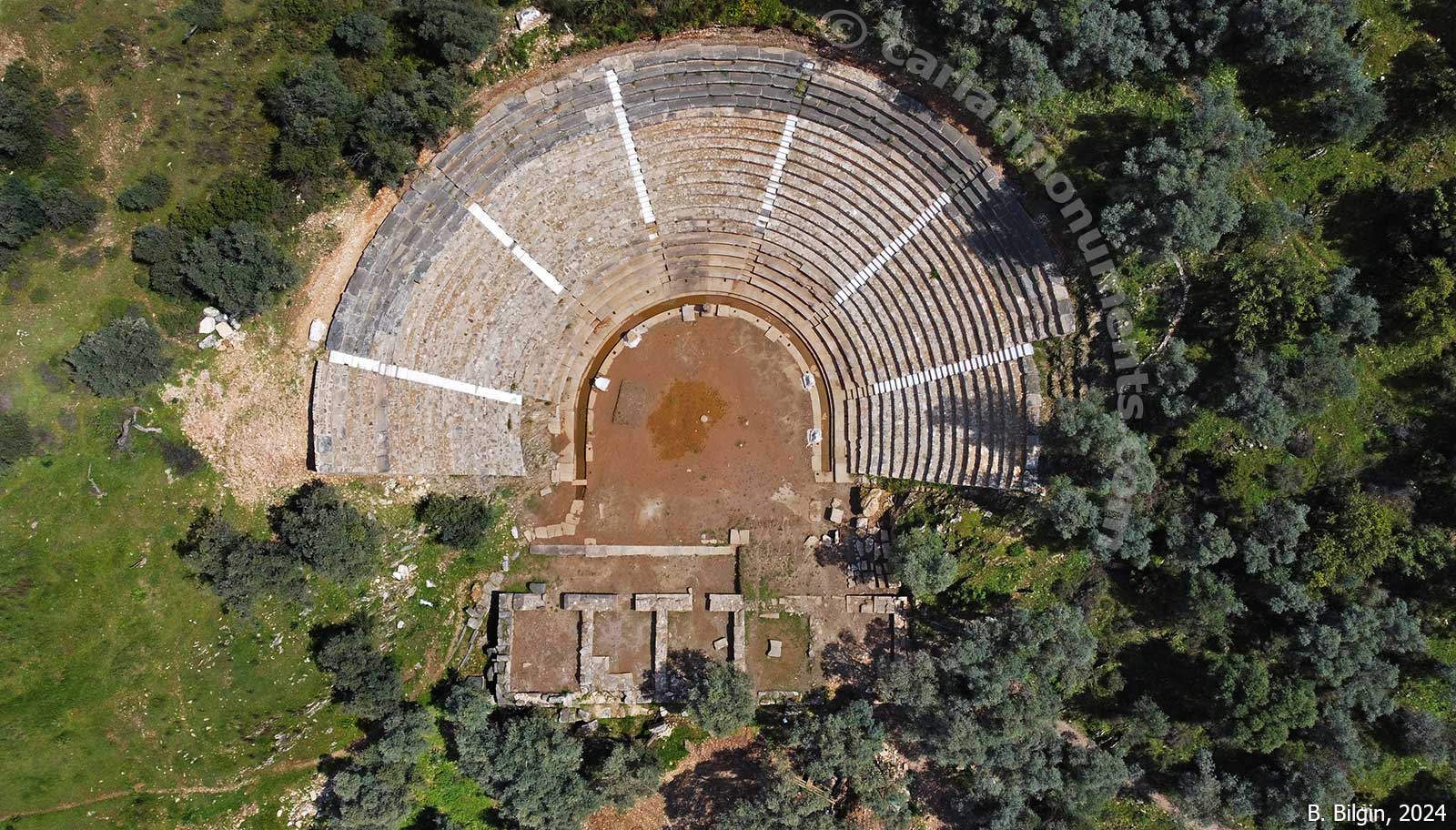
In 18th and 19th centuries, the site was visited and documented by travelers such as Chandler, Choiseul-Gouffier, and Ch. Fellows, who focused primarily on the temple. The first systematic excavations also concentrated on the Temple of Zeus Lepsynos by Ümit Serdaroğlu in 1969–1975. The ongoing excavations on the site was started in 2011 by Abuzer Kızıl, and expanded beyond the temple to include the Hellenistic period with Roman usage agora on the plain, and the theater with a 2000–2500 spectators capacity in the hillside, necropolises, a Roman bath featuring a hypocaust system and mosaic floors, 2.5 km fortification wall with round and square towers, and necropolises on the north and south of the city.




Temple of Zeus Lepsynos
The most prominent structure at Euromos is the Temple of Zeus Lepsynos, one of the best-preserved temples in Asia Minor. The surviving temple dates to the Roman Imperial period (the reign of Hadrian, approximately the 2nd century CE) and was built in the Corinthian order with a 6 × 11 column arrangement. It is believed that the temple was never fully completed, as some of its columns were left unfluted. The presence of a double-axe symbol (labrys) flanked by ears on an orthostat in the southern cella suggests that the cult of Zeus Lepsynos practiced here may have been associated with oracular functions. Several columns also bear Greek dedicatory inscriptions.
Excavations have revealed that the Roman temple was constructed atop earlier Archaic and Hellenistic sanctuaries. Recent discoveries include Archaic terracotta architectural elements and a Hellenistic altar. Excavations carried out in 2021 and 2022 brought to light significant Archaic kouros statues. Two of these, found near the temple, are rare examples of Leontophoroi (lion-bearers), one depicted nude and the other armored. The nude kouros bears an inscription in the Carian language on its left leg.


References:
Choiseul-Gouffier, M. G. F. 1782. Voyage Pittoresque de la Grece, Paris.
Fellows, C. 1839. A Journal Written During an Excursion in Asia Minor, London.
Kızıl, A. et al. 2016. “Eurômos : rapport préliminaire sur les travaux réalisés en 2015,” Anatolia Antiqua 24, 321-338.
Kızıl, A. & L. Talatas. 2024. “Two Archaic Leontophoroi Statues from Euromos,” Revue Archéologique 2, 229-253.
Kızıl, A. & M. Çur. 2025. “Euromos Antik Kenti 2022-2023 Yılları Çalışmaları,” in Muğla Kazı ve Araştırmaları 1, ed. B. Söğüt , Ankara, pp. 93–106
Kızıl, A. & M. Çur. 2025. “Euromos Antik Kenti Kazıları ve Araştırma Sonuçları Üzerine Güncel Bir Değerlendirme,” bitig Edebiyat Fakültesi Dergisi 5/9, 117–139.
de Laborde, L. 1838. Voyage de l’Asie Mineure Par Mrs. Alexandere de Laborde, Becker, Hall et Leon de Laborde, Paris.
Images:
M. G. Choiseul-Gouffier, 1782
L. de Laborde, 1838
C. Fellows, 1839
Ertuğrul Anıl, 2009
Bora Bilgin, 2009, 2025, 2026
Tayfun Bilgin, 2026
Reha Özer, 2026