All Carian inscriptions around Silsilis are graffiti, likely left by mercenaries.
E.Si 1
The graffito is on a sandstone rock at the west bank about 9 km north of Gebel el-Silsila and 3 km north of Wadi Shatt el-Rigal, in the neighborhood of E.Si 2 (see below). It was first published in 1905 by Legrain. A better copy of it was published by Sayce in 1908.

(←)
1 k̑iqud marariso[…]
E.Si 2
The graffito is on the lower part of the south face of a large boulder on the western bank of the Nile, opposite Silwa, about 3 km north of Wadi Shatt el-Rigal. It was discovered in 1892 by A. Sayce. Below the graffito are the drawings of a dog chasing birds. The inscription inicludes the name Psmaśk, likely the Carian version of Psamtik, and thus associated with the military campaign of Psamtik II to Nubia. The word qan in the second line is speculated to mean ‘dog.’


(⇄)
1 [..]ek̑lδ wa psmaśkś
2 uejresi qan kolt kowrn[…?]
E.Si 3
The graffito is inscribed on the summit of a rock alongside numerous Greek and Egyptian graffiti, about a quarter of a mile to the south of E.Si 2. It was discovered in early 1892 by A. Sayce.

(←)
1 irasa n[.]eakrnanb
E.Si 4
The graffito was discovered shortly before 1905 by G. Legrain and is located roughly 9 km north of Gebel el-Silsila, at the at the edge of a small valley (at the time) known as Khor el-Ghorab el-Bahari, deeply cut on the upper surface of a rock, almost on a level with the ground.

(→)
1 […]t? bebint sqlumidun sqla
E.Si 5
The graffito was discovered shortly before 1905 by G. Legrain at Gebel Abou Gorab, located roughly 9 km north of Gebel el-Silsila, on the eastern bank of the Nile. Its is described to be very lightly engraved on the rocks, showing distinctly on the weather-stained stone, at a location around the small valleys (at the time) knows as Khor Daba and the Khor el Waza.

(→)
1 beτkrqit[…]
E.Si 6–9
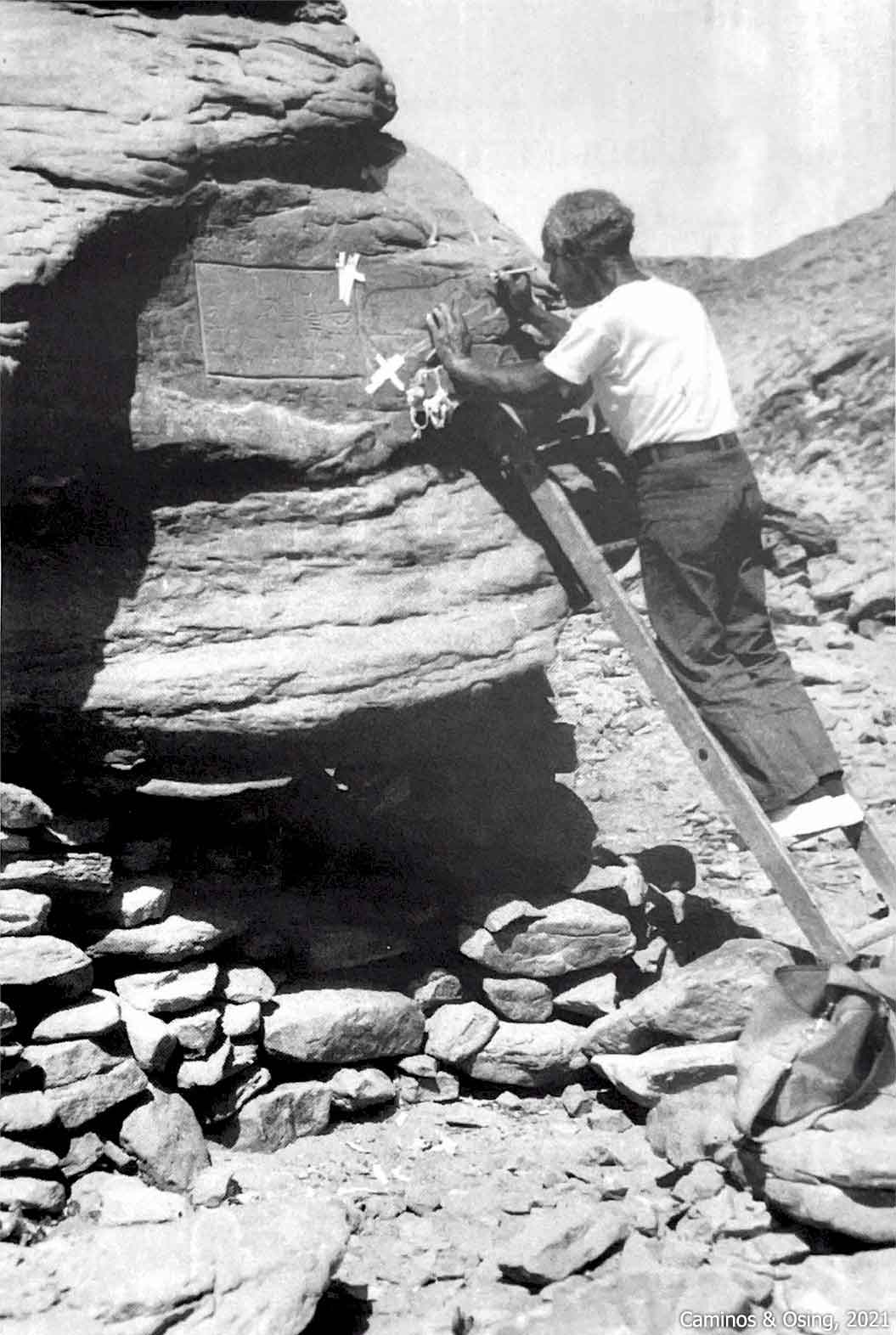
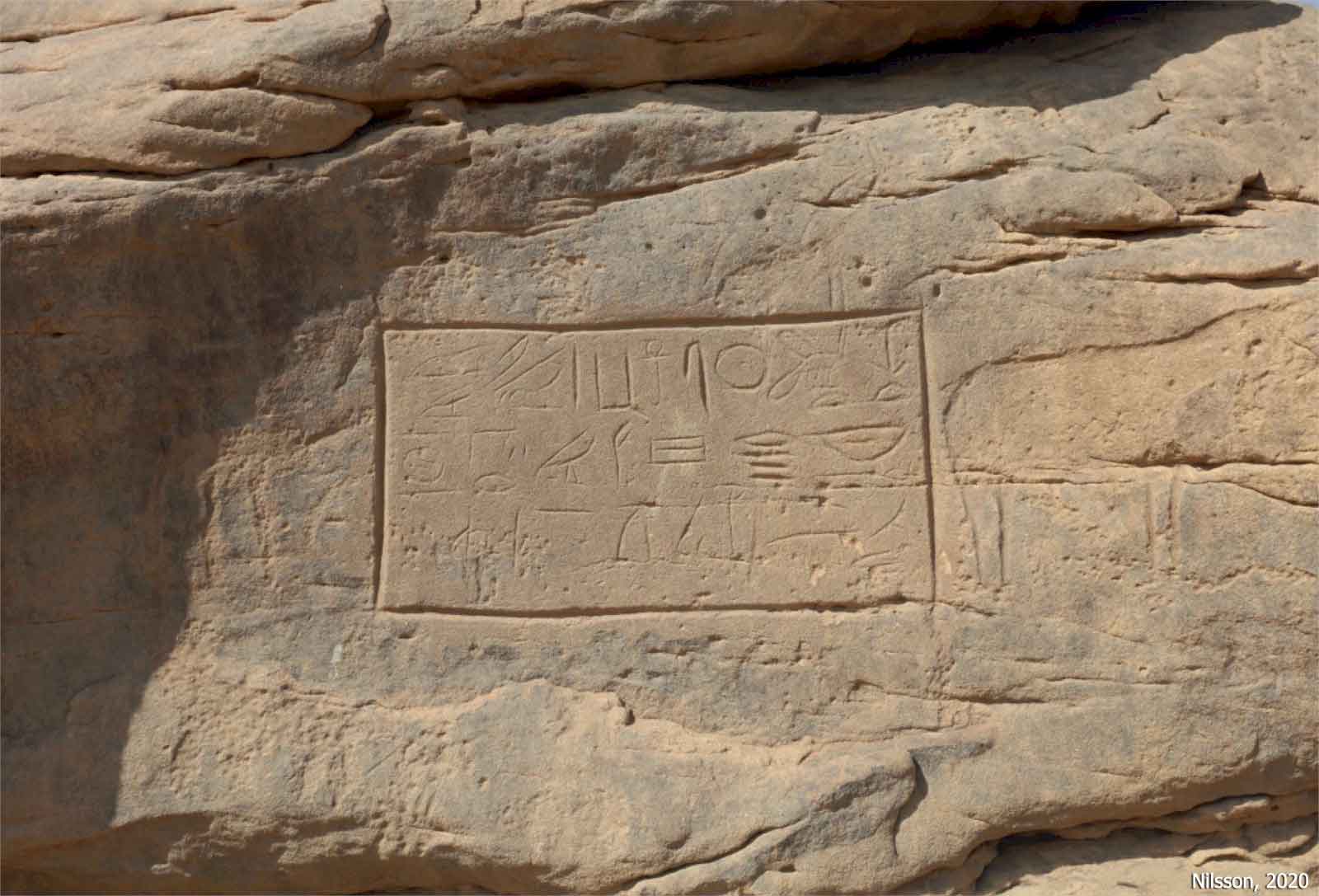
This group of graffiti are all written on the same boulder. The lightly incised inscriptions are hardly visible on the photographs.

E.Si 6
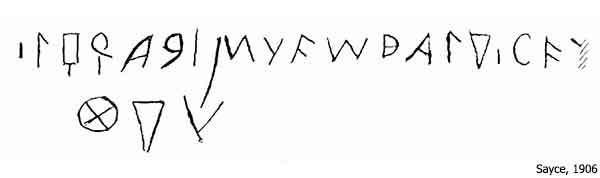
The graffito was discovered by A. Sayce in 1906 on a sandstone boulder on the south side of the entrance to the Wadi Shatt el-Rigal. It is very lightly incised just above an Egyptian inscription of the 11th dynasty.

(→)
1 býtaš sursiabk dr[…] qku
E.Si 7
The graffito is on the same boulder as E.Si 6, very lightly incised on right side of the hieroglyphic inscription, right below the drawing of a donkey like animal. It was discovered in 1906 by A. Sayce.
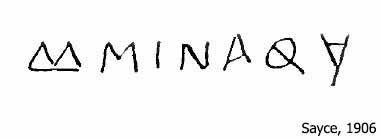

(→)
1 psmaśk
E.Si 8
The graffito is on the same boulder as E.Si 6, very lightly incised on right side of the Egyptian inscription. It was discovered in 1906 by A. Sayce.


(→)
1 bijśśpe …
E.Si 8b(?)
This graffito, which is visible in the drawings of the epigraphic survey project of Wadi Shatt el-Rigal (Caminos & Osing, 2021), does not seem to have been published. It is on the same rock as E.Si 6–9, below E.Si 8 and above E.Si 7. The transliteration attempt is mine and remains very uncertain.

(→?)
mlkerśkr[.]osd?
l?[…]j[..].rn
E.Si 9
The graffito is on the same boulder as E.Si 6, very lightly incised on right side of the Egyptian inscription, below an animal figure. It was discovered in 1906 by A. Sayce.


(→)
1 […]rbnša[…]
E.Si 10
The graffito is on a rock on the slope of the cliff about a quarter of a mile north of El-Hammam near a late Roman cemetery. It was discovered in 1906 by A. Sayce.

(←)
1 k̑?mpi
E.Si 11
Per Sayce, this is a large and deeply-incised inscription facing the river, on a boulder a few yards to the north of that on which E.Si 10 is engraved. It was discovered in 1906 by A. Sayce. The rightmost sign is not considered to be a letter, but a decorative extension of the frame.

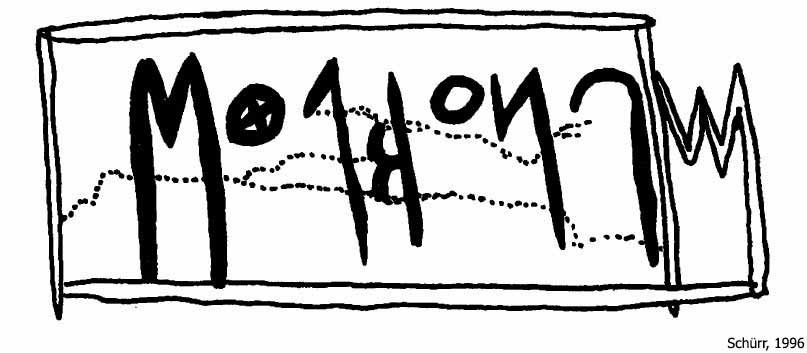
(←)
1 dmošbqs
References:
Adiego, I.- J. 2007. The Carian Language, Leiden/Boston. (E.Si 1–E.Si 11)
Caminos, R. A. & Osing, J. 2021. The Wadi Shatt el-Rigal, London. (4B, 4C, 4E, 4F = E.Si 6–E.Si 9)
Legrain, G. 1905. “Inscriptions from Gebel Abou Gorâb,” Proceedings of the Society of Biblical Archaeology 27, 129. (Nos. A–D = E.Si 2, E.Si 4, E.Si 1, E.Si 5)
Sayce, A. H. 1895. “The Karian and Lydian inscriptions,” Proceedings of the Society of Biblical Archaeology 17, 39–43. (Nos. II.1–2 = E.Si 2–E.Si 3)
Sayce, A. H. 1905. “Lydian and Karian inscriptions,” Proceedings of the Society of Biblical Archaeology 27, 123–128 Lám. I–II. (No. II = E.Si 4)
Sayce, A. H. 1906. “An inscription of S-ankh-ka-ra. Karian and other inscriptions,” Proceedings of the Society of Biblical Archaeology 28, 171–177. (Nos. I–VI = E.Si 6–E.Si 11)
Sayce, A. H. 1908. “Karian, Aramaic, and Greek graffiti from Heshân,” Proceedings of the Society of Biblical Archaeology 30, 28–29 and Plt. I. (No. I = E.Si 1)
Schürr, D. 1996. “Zur karischen Felschinschrift Si. 62 F”, Kadmos 35, 149–156. (E.Si 11)
Winkler, H. A. 1939. Rock Drawings of Southern Upper Egypt II, London. (Plt. VIII-2 = E.Si 11)
Images:
A. H. Sayce, 1895, 1905, 1905, 1908
G. Legrain, 1905
H. A. Winkler, 1939
D. Schürr, 1996
M. Nilsson, 2020 (AE 120 p. 37)
R. A. Caminos & J. Osing, 2021
T. Bilgin, 2026