G 1
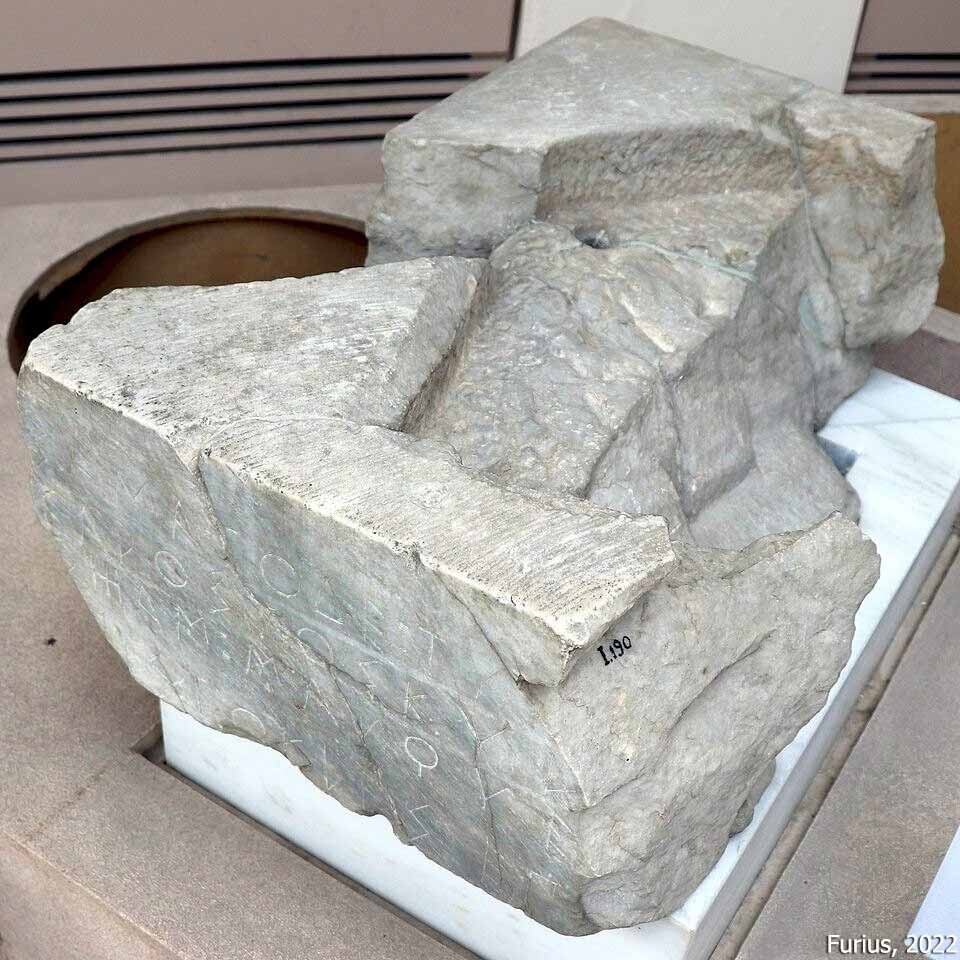
This inscription was discovered in 1954 by the ephor Threpsiades during excavations on a street south-southwest of the Kerameikos, in Athens, where it had been reused as building material in the construction of the Themistoclean wall. The third line of the inscription on the white marble funerary base is Carian while other lines are in Greek. The right side of the block is mutilated, but the Carian text is mostly preserved. The Greek text identifies the monument as belonging to “Tyr[ ] the Carian, son of Skylax” and contains the signature of the sculptor Aristokles. This bilingual was foundational to the decipherment of Carian, as it helped determine the meaning of śjas as “tomb” or “monument” and identified san as a demonstrative pronoun (“this”). It is dated to the last quarter of the 6th century BCE. The inscribed block is housed in the Kerameikos Museum in Athens (Inv. No. I 190).


(→)
1 śjas san tur[…]
Greek text:
1 σε͂μα τόδε : Τυρ[—–] This is the tomb of Tyr[…]
2 Καρὸς τō Σκύλ[ακος] from Caria, son of Skylax.
3 (Carian line)
4 [Ἀ]ριστοκλ͂ες ἐπ[οίε̄σεν] Aristokles made it.
G 2
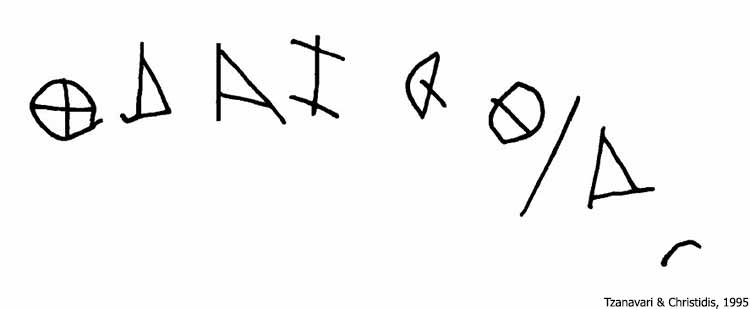
The Attic black-glazed skyphos (a drinking cup) fragment (10.4 x 5.1 cm) was discovered during rescue excavations in 1991–1992 at the “Lebet Table,” a site situated on the northwest side of the Thessaloniki valley. The inscription is a graffito incised (after firing) on its external base surface. The text consists of one complete word followed by a vertical dividing stroke and the beginning of a second word. The complete word is interpreted as a personal name. Based on the typology of the pottery, it is dated to the third quarter of the 5th century BCE. The item is in the Thessaloniki Archaeological Museum.

(→)
1 qlaλiś k?[…]
G 3
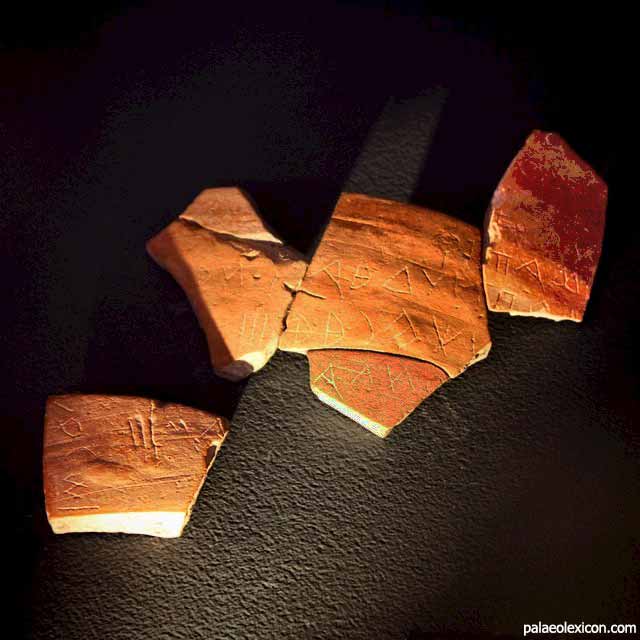
It was found during archaeological excavations in 1995 and 1996 at Karabournaki (ancient Therme), near Thessaloniki. The inscription is incised on six sherds belonging to the same Ionic closed vessel (possibly an amphora or large oinochoe) decorated with orange-red bands. The letters were incised after the vessel was broken. The largest joined fragment measures 12 x 10.7 cm. The text is written from right to left. It includes carelessly incised personal name sequences and numerical symbols, leading scholars to conclude it has a commercial character related to local trade. Paleographically, it is significant for using the sign j, a letter typically associated with the Egyptian alphabetic variant. The vessel is dated to the 5th century BCE. The fragments are in the Thessaloniki Archaeological Museum.

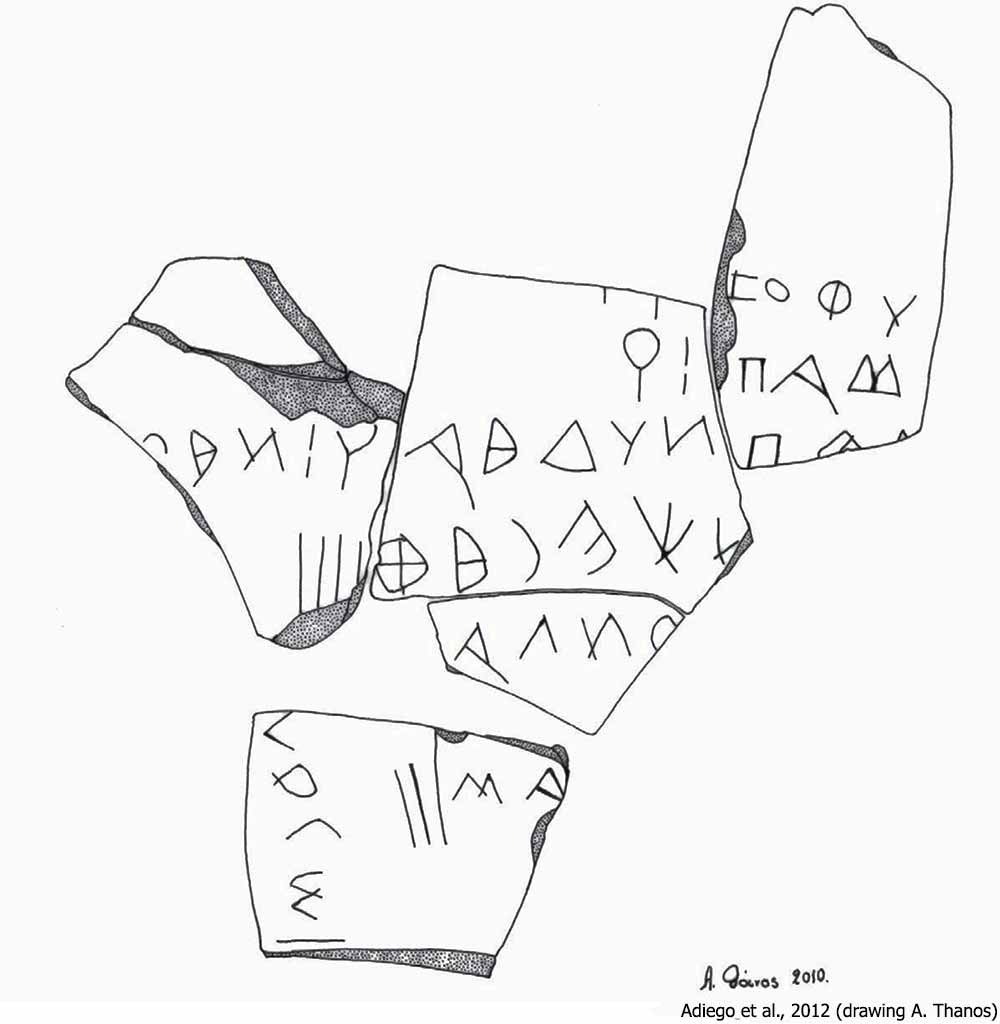
(←)
Frg.1 uśoλ xx paw? t xxem uliat mid?[…] m?nydiq IIII
Frg.2 o/tmba[…]
Frg.3 […]b/s?odŋ II
G 4
It was discovered in 2001 at Karabournaki, Thessaloniki. The inscription is on a fragmentary roof tile consisting of two joined sherds (9.1 x 15 x 1.7 cm) covered with a deep red slip. The object contains two independent texts (labeled a and b) both written from left to right. Only a few letters are preserved, but the presence of the specific Carian letter I and the sequence ismn (associated with Carian name Ismenda) supports its Carian identification. It is attributed to the Archaic period, consistent with the majority of pottery found in that stratigraphic context. It is in the Thessaloniki Archaeological Museum(?).


(→)
Part a […]t […]tmb […]tt […]tt […]j?om tt […]xλ xb x x
Part b […]ś b ismn II […]ym II
References:
Adiego, I.- J. 2007. The Carian Language, Leiden/Boston. (G 1–G 2)
Adiego, I.- X. 2019. “’Archaic’ Carian,” in Karia Arkhaia. La Carie, des origines à la période pré-hekatomnide. 4èmes Rencontres d’archéologie de l’IFÉA. Istanbul, 14-16 novembre 2013, eds. O. Henry, K. Konuk, Istanbul, 23–41. (31–33)
Adiego, I.-J., Tiverios, M., Manakidou, E. & Tsiafakis, D. 2012. “Two Carian inscriptions from Karabounaki/Thessaloniki, Greece,” in Stephanèphoros. De l’économie antique à l’Asie Mineure. Hommages à Raymond Descat, ed. K. Konuk, Bordeaux, 195-202. (G 3–G 4)
Deroy, L. 1955. “Les inscriptions cariennes de Carie,” L’Antiquité Classique 24, 305–335. (334–335)
Tzanavari, K. & Christidis, A.-Ph. 1995. “A Carian Graffito from the Lebet Table, Thessaloniki,” Kadmos 34, 13–17.
Images:
K. Tzanavari & A.-Ph. Christidis, 1995
I.- J. Adiego, 2007
I.- J. Adiego, et al., 2012
Furius, 2022 (CC0 1.0)
Jona Lendering (CC0 1.0)
palaeolexicon.com