C.Ka 1
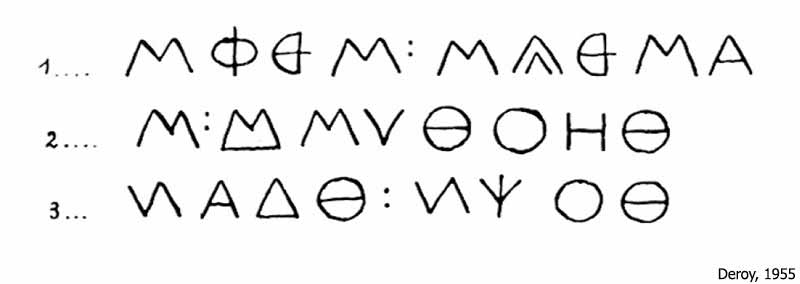
Discovered in 1948 at a location called Mezargediği west of Kaunos by G. E. Bean, this marble stone lintel (77 x 48 x 46 cm) from a destroyed tomb bears a four-line funerary inscription that might be read “(Tomb) of Psuśol, the son of Mal” (Adiego 2007). It is kept at the depot of the Kaunos excavation house. It probably dates to the 4th or 3rd century BCE.


(→)
1 sñis
1-2 sδisas
2 psuśoλś
3 malś mnoś
C.Ka 2
Discovered by G. E. Bean in 1949 in the central sanctuary of Kaunos, behind the Hellenistic stoa, this this gray limestone stele fragment (47 x 49 x 21.5 cm) with 14 lines is the longest known Carian text. While largely impenetrable, it is believed to contain official political or religious regulations. It is kept at the depot of the Kaunos excavation house. It may date to the 4th or 3rd century BCE.


(→)
1 [ui?]omλŋ qrds γrds o[.]i
2 […]r sb ak̑mnnartnyr obsmns[…]
3 [.]k̑arλanoŋ sb zšariosŋik̑ […]
4 [.]nudrmak̑yrpai sarniš sb u[…]
5 [.]aT punoτ2 otrš bi sb ak̑tmsk[m …?]
6 [.]δ bi 𐋆aitk ouor γδbšλaŋ𐋆i [.]
7 […] sarniš sb 𐋆orsolš sb uTbit
8 [.]bi qrdsoλš ait 𐋆mali Tk̑it
9 [.]intnor k̑yrapaiś umoλτ2oba
10 [.]δiurt obsmsmñ𐋆ñ ouor mt𐋆yr
11 […]abrunk̑ur[.]šynšTynn sb
12 […]tbsms 𐋆mali […]
13 […]maT sb an[…]
14 […]ba
C.Ka 3
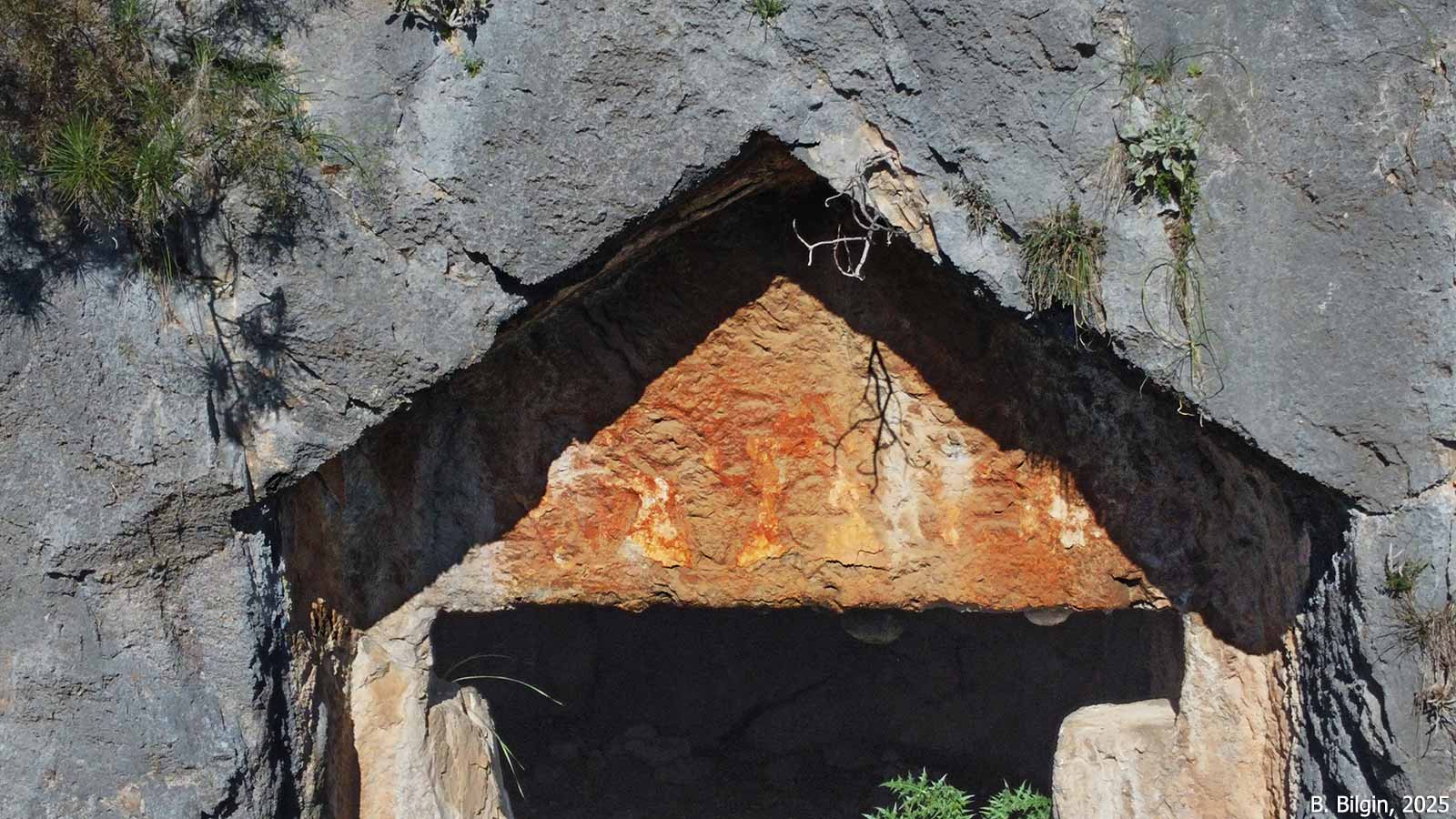
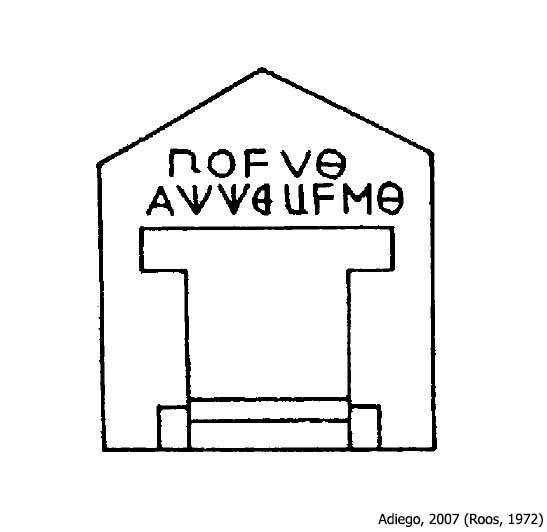
The inscription is carved on the facade above the entrance of a rock-cut tomb (E 1 in the Roos system) at Kaunos with very large letters ranging 17 to 21 cm in height. The content is a brief funerary onomastic formula: “This (tomb is) of Soru, (son) of iβrs” (Adiego 2007). While pottery in the tomb dates to the mid-4th century BC, paleographic analysis suggests the inscription is younger than the Kaunos bilingual, likely dating to the 3rd century BCE.

(→)
1 šoruś
2 ann iβrsś
C.Ka 4
A fragment of a gray limestone stele (13 x 25 x 25 cm) found in 1971 during excavations at the north side of the Agora. It was originally suspected to be a part of the long stele C.Ka 2, but modern measurements show it is 3 cm thicker than that stone, confirming it as an independent document. Its context remains unknown. The fragment is kept at the depot of the Kaunos excavation house.

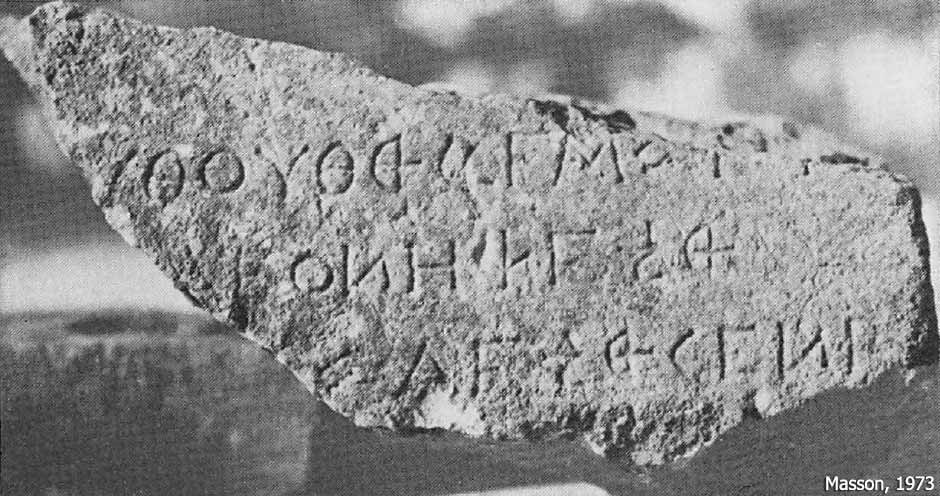

(→)
1 […]uśouś iβrsδr[.]
2 […]ayomλn𐋆ri
3 […]dar𐋆idymš
C.Ka 5
Two fragments of this blue-gray marble stele were found in summer 1996 by an excavation team under Baki Öğün and Cengiz Işık, and a third matching fragment was unearthed in 1997. They were found near a terrace wall behind the Stoa, an area that also yielded Hekatomnid statue bases. Three fitting pieces combined have a total height of 46.5 cm, max width of about 27 cm and a thickness of 8.5 cm. It bears parts of a bilingual inscription with 18 lines in Carian and 8 lines in Greek, which is often referred to as the “Kaunos Bilingual.” The text is a decree honoring two Athenian citizens, Nikokles and Lysikles, as proxenoi and eueregetai (benefactors). This document was instrumental in confirming the modern decipherment of Carian. It dates to the last quarter of the 4th century BCE, specifically 322 or 314 BCE, during the post-Hekatomnid era. The stele is in Fethiye Museum.
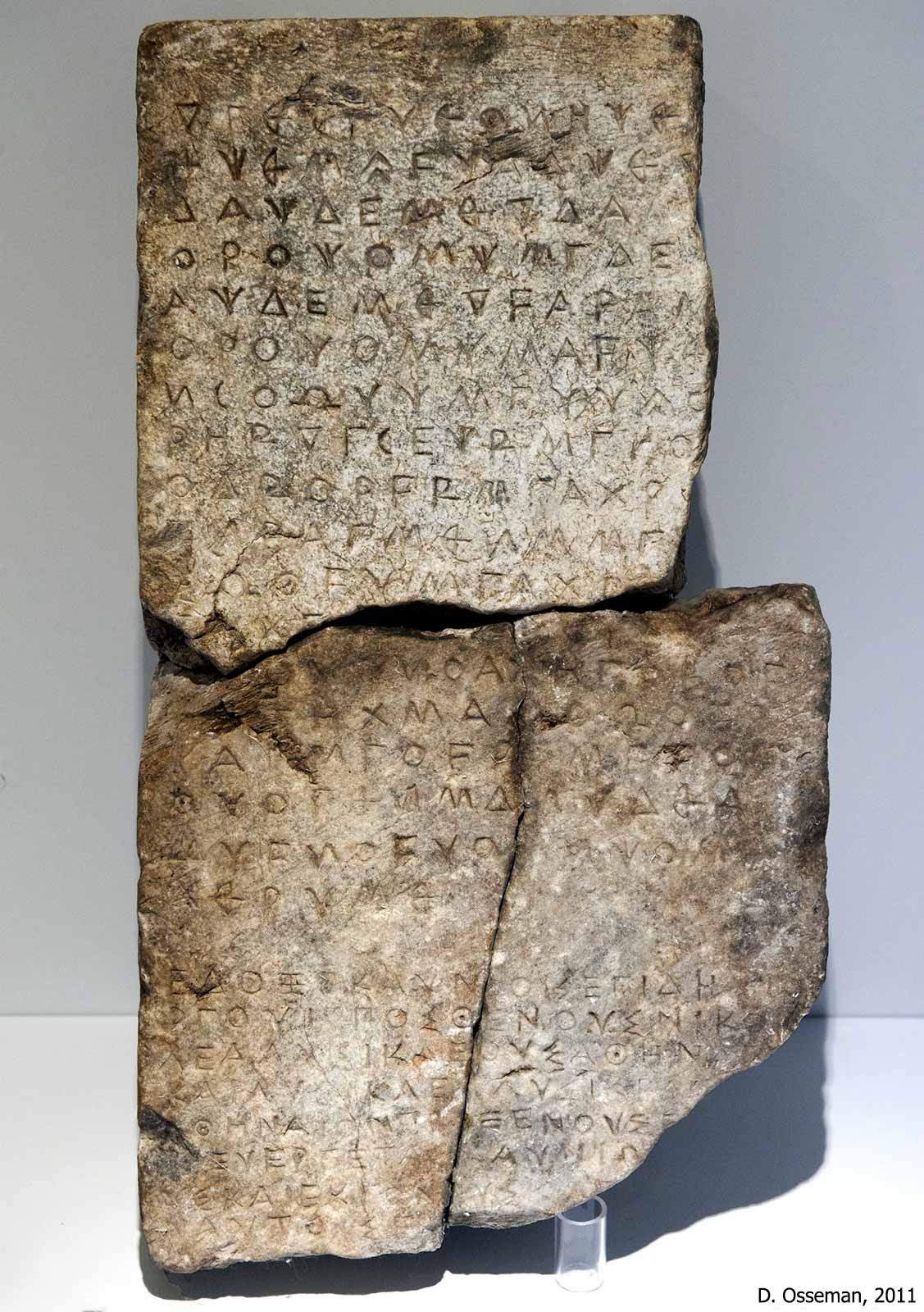

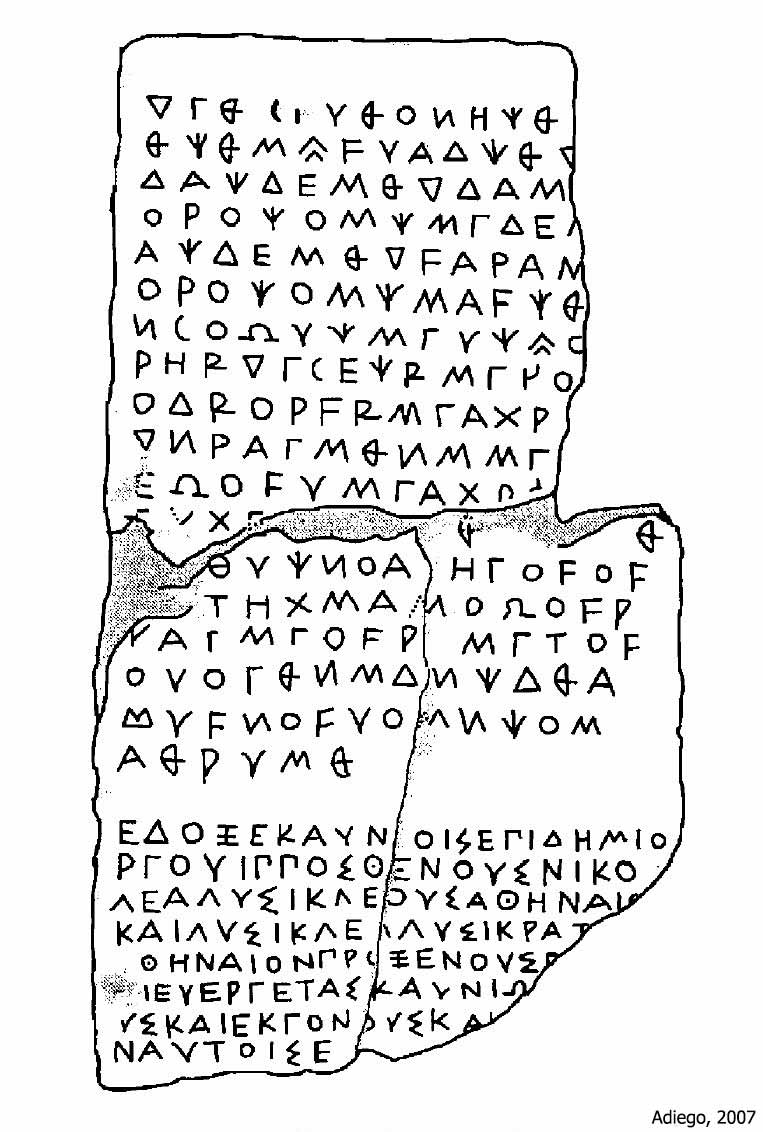
(→)
1 kbidn uiomλn
1-2 i[…]ini
2 sδrual
2-3 nik[ok]lan
3 lysiklas[n]
4 otonosn sb
4-5 lys[ikl]an
5 lysikratas[n]
6 otonosn sarni[š]
7 mdoτ2un sb
7-8 unδo[…]tλš
8 kbdynš sb
8-9 β2o[…]olš
9 otrš sb
9-10 ak̑t[ms]km
10 tabsims sb […]
11 yτ2oru sb ak̑t[…]
12 buky[…]i[…]I
13 […]śunmoa[.]λboror
14 […]𐊱λk̑sasoτ2 ort
15 tab sb ort[.] sb
15-16 𐊱orouo
16 i mslmnlia
17 purmoruos mnos
18 aitusi
Greek text:
1 ἔδοξε Καυν[ί]οις, ἐπὶ δημιο-
ργοῦ Ἱπποσθένους· Νικοκ-
λέα Λυσικλέους Ἀθηναῖο[ν]
καὶ Λυσικλέα Λυσικράτ[ους]
5 [Ἀ]θηναῖον προξένους ε[ἶναι κ]-
[α]ὶ εὐεργέτας Καυνίω[ν αὐτο]-
ὺς καὶ ἐκγόνους καὶ [ὑπάρχει]-
ν αὐτοῖς ε[ἴσπλουν καὶ ἔκπλουν]
[— — — — — — — — — — — —]
Marek, 2006:
The Kaunians have decided. Hipposthenes was demiurgos. Nikokles, son of Lysikles, an Athenian, and Lysikles, son of Lysikrates, an Athenian, shall be proxenoi and benefactors of the Kaunians—they themselves and their descendants—and they shall have E[—]
C.Ka 7
The inscription consists of a three-letter graffito on an Attic bowl fragment found in 1998 at the sanctuary beneath the so-called palaestra terrace in Kaunos. The inscription is identified as a personal name (in the genitive form). The fragment is dated to the 4th century BCE and kept at the Kaunos excavation house.


(→)
1 […] noś
C.Ka 8
The inscription is located on two blocks on the western side of a terrace wall of the so-called Sanctuary of Demeter. It is written with about 7 cm high letters in two lines with the second one having only two letters. It remains in situ as part of the sanctuary wall. The inscription is paleographically dated to the late 4th century BCE, but the nature of the text remains unknown.

(→)
1 potkośλś?aba?δ?
2 ya
C.Ka 9
The lidded bowl (lekanis) fragment (2.5 x 11.5 cm) with a graffito incised on its rim was found in 1990 in the middle of the stoa in Kaunos. The inscription is notable for its archaic sign forms, and it is the oldest inscription found in Kaunos. The bowl fragment has been dated to the late 6th century BCE. It was housed in the Kaunos excavation depot (Inv. 1708090 ST).

(→)
1 […]ois?ur?mλo
C.Ka 10
This short inscription was discovered in 2006 by the archaeologist B. Schmaltz during his work on the city walls of Kaunos. It is carved into a blue-gray marble block on the exterior face of the northern section of the western city wall, approximately 20 m south of the gate located north of Sivrihisar. The inscription consists of three letters in a single line of text measuring 10.6 cm in length, with a letter height of 7 to 8 cm. Linguistically, it is interpreted as a personal name possibly of a craftsman or architect. It is likely to be contemporary with the wall which has been dated to the last quarter of the 3rd century BCE.
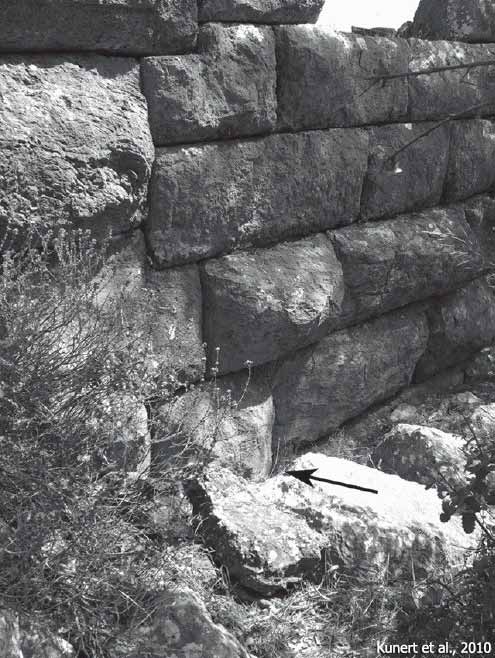

(→)
1 orm
C.Ka 11
The white marble fragment (18 x 9 x 5 cm) from the rim of a large round basin was found in 2016 during excavations at the sanctuary of Apollo in Kaunos. The original basin is estimated to have had a total diameter of approximately 84 cm. The three character inscription interpreted to be the beginning of a votive text (“This [object…]”). The fragment is dated to the first quarter of the 5th century BCE and is probably kept at the Kaunos excavation house.
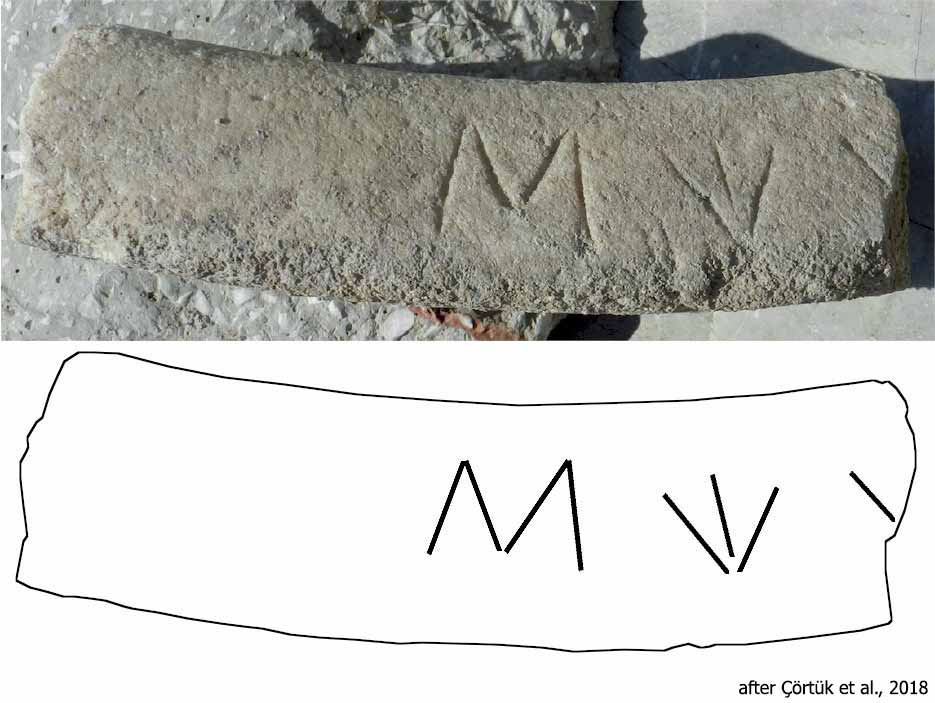
(→)
1 snṇ[
References:
Adiego, I.- J. 2007. The Carian Language, Leiden/Boston. (C.Ka 1– C.Ka 9)
Adiego, I.- X. 2019. “’Archaic’ Carian,” in Karia Arkhaia. La Carie, des origines à la période pré-hekatomnide. 4èmes Rencontres d’archéologie de l’IFÉA. Istanbul, 14-16 novembre 2013, eds. O. Henry, K. Konuk, Istanbul, 23–41. (34)
Bean, G. F. 1953. “Notes and inscriptions from Caunus,” Journal of Hellenic Studies 73, 10–35.
Çörtük, U., Gander, M. & Holler, B. 2018. “Das Fragment eines Kultgegenstandes mit karischer Inschrift aus Kaunos,” Kadmos 57, 107–128.
Deroy, L. 1955. “Les inscriptions cariennes de Carie,” L’Antiquité Classique 24, 305–335. (319–320).
Frei, P. & Marek, C. 1997. “Die karisch-griechische Bilingue von Kaunos. Eine zweisprachige Staatsurkunde des 4. Jh.s v. Chr.,” Kadmos 36, 1–89.
Frei, P. & Marek, C. 1998. “Die karisch-griechische Bilingue von Kaunos. Ein neues Textfragment,” in Colloquium Caricum, ed. W. Blümel, Berlin, 1–18.
Frei, P. & Marek, C. 2000. “Neues zu den karischen Inschriften von Kaunos,” Kadmos 39, 83–132.
Kunnert, U., Schürr, D. & Zingg, E. 2010. “Eine neue karische Mauerinschrift aus Kaunos,” Kadmos 49, 169–180.
Marek, C. 2006. Die Inschriften von Kaunos, München.
Masson, O. 1973[75]. “Un nouveau fragment d’inscription carienne de Kaunos”, Anadolu 17, 123–131 and plts. I–II.
Robert 1950. “Inscriptions inédites en langue carienne,” Hellenica VIII, 5–22, and plts. I–XXX. (18, 21 and plts VI-3, IX-1, XXVIII-1).
Roos, P. 1972. The Rock-Tombs of Caunus I, Göteborg. (93 and plt. 40)
Schürr, D. 1996. “Zur karischen Felsgrabinschrift von Kaunos (28*),” Kadmos 35, 157–159.
Schürr, D. 2001. “Karische und lykische Sibilanten,” Indogermanische Forschungen 106, 94–121.
Schürr, D. 2010. “Rezension von The Carian Language by I.-J. Adiego,” Kratylos 55, 134–142.
Images:
L. Robert, 1950
L. Deroy, 1955
O. Masson, 1973[75]
I.-J. Adiego, 2007
U. Kunnert, D. Schürr, E. Zingg, 2010
Dick Osseman, 2011 (CC BY-SA 4.0)
U. Çörtük, M. Gander, B. Holler, 2018
Bora Bilgin, 2025