E.Sa 1
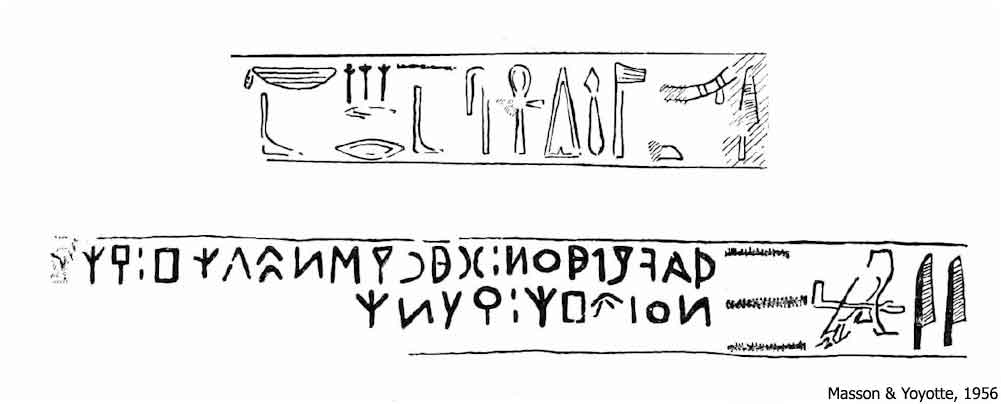
The inscription is on a bronze reliquary for mummified reptiles found in Sais in 1894. It is in the inventory of Cairo Museum. The first word of the inscription (Šarkbiom) is apparently the same personal name mentioned in the accompanying Egyptian text (Š3rkbym).


(←)
1 šarkbiom zidks mδane
1-2 ýn[.]mo
2 δen tumn
Egyptian text: Ɉtm nṯr ‘3 dj ‘nḫ snb Š3rkbym, “Atum the great god may give life and health to Š3rkbym.”
E.Sa 2
The inscription is written in right-to-left orientation on the base of a bronze votive statuette of the Goddess Neith (h: 37.9 cm, base: 12.8 x 4.3 x 1.3 cm) that was found in 1891 in Sais. The accompanying Egyptian inscription mentions “P3-dj-Njt son of K3rr,” which correspond to the Carian “Pdnejt (son) of Qýri”. The inscription is dated to the reign of Psamtik I (663–609 BCE) making this the oldest datable Carian inscription from Egypt. It is currently in the Ägyptisches Museum in Berlin (ÄM 13785).


(←)
1 pdnejt qýriś k̑i
References:
Adiego, I.- J. 2007. The Carian Language, Leiden/Boston. (E.Sa 1–E.Sa 2)
Ćwiek, A. 2005, Śmierć i życie w starożytnym Egipcie, Poznan (Fig. 74)
Masson, O. & Yoyotte, J. 1956. Objets pharaoniques à inscription carienne, Cairo. (Docs. L, M)
Images:
O. Masson & J. Yoyotte, 1956
A. Ćwiek, 2005
I.- J. Adiego, 2007