
C.Tr 1
This limestone slab (35 x 37 x 9 cm) was discovered around 1888 among the ruins of the Acropolis of Tralleis (modern Aydın). While the original stone was reportedly collected by a local collector, it has disappeared since then. A squeeze is preserved at the Austrian Academy of Sciences in Vienna. The funerary inscription likely has an onomastic formula recording personal names and patronymics. It is unique for being written in a right-to-left orientation, which is atypical for the Carian homeland. Most inscriptions from Caria proper date to the 4th/3rd century BCE, but the sinistroverse orientation is an archaic trait.
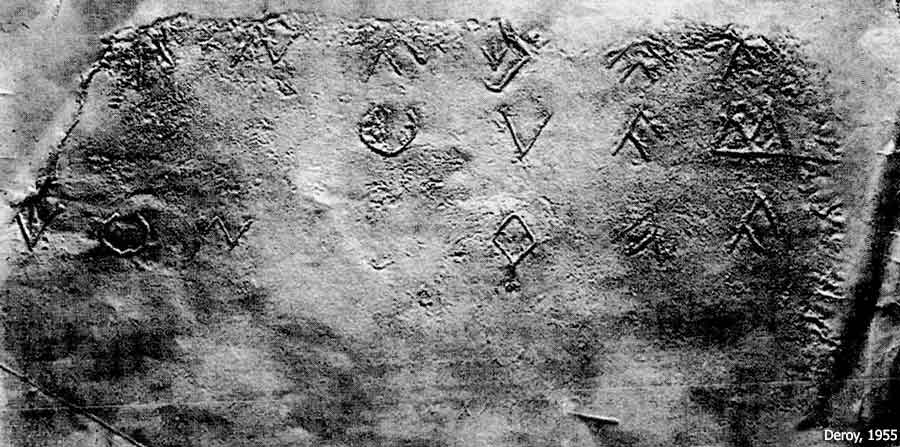

(←)
1 sδi? amτ[…]
2 pauś
3 art{ }mon
C.Tr 2
Discovered in 1871 in a vineyard near Kemer, northwest of Tralleis, this quadrangular stone has since disappeared, and is documented only through 19th-century drawings. Like C.Tr 1, it is a funerary text and follows standard Carian onomastic patterns, primarily recording personal names.

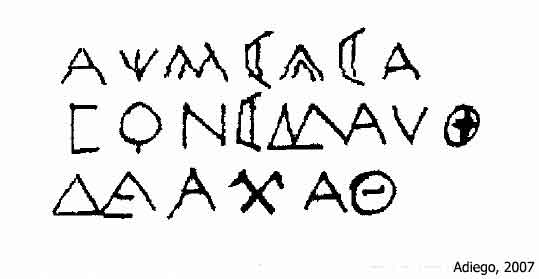
(→)
1 an siδi
1-2 artmi
2 pauś
3 parŋa =q
References:
Adiego, I.- J. 2007. The Carian Language, Leiden/Boston. (C.Tr 1, C.Tr 2)
Deroy, L. 1955. “Les inscriptions cariennes de Carie,” L’Antiquité Classique 24, 305–335. (307–308 and pl. I)
Meier, M. 1978. “Karika,” Kadmos 17, 76–84. (81)
Schürr, D. 2001. “Karische und lykische Sibilanten,” Indogermanische Forschungen 106, 94–121. (109 n.12)
Images:
L. Deroy, 1955
M. Meier, 1978
I.- J. Adiego, 2007